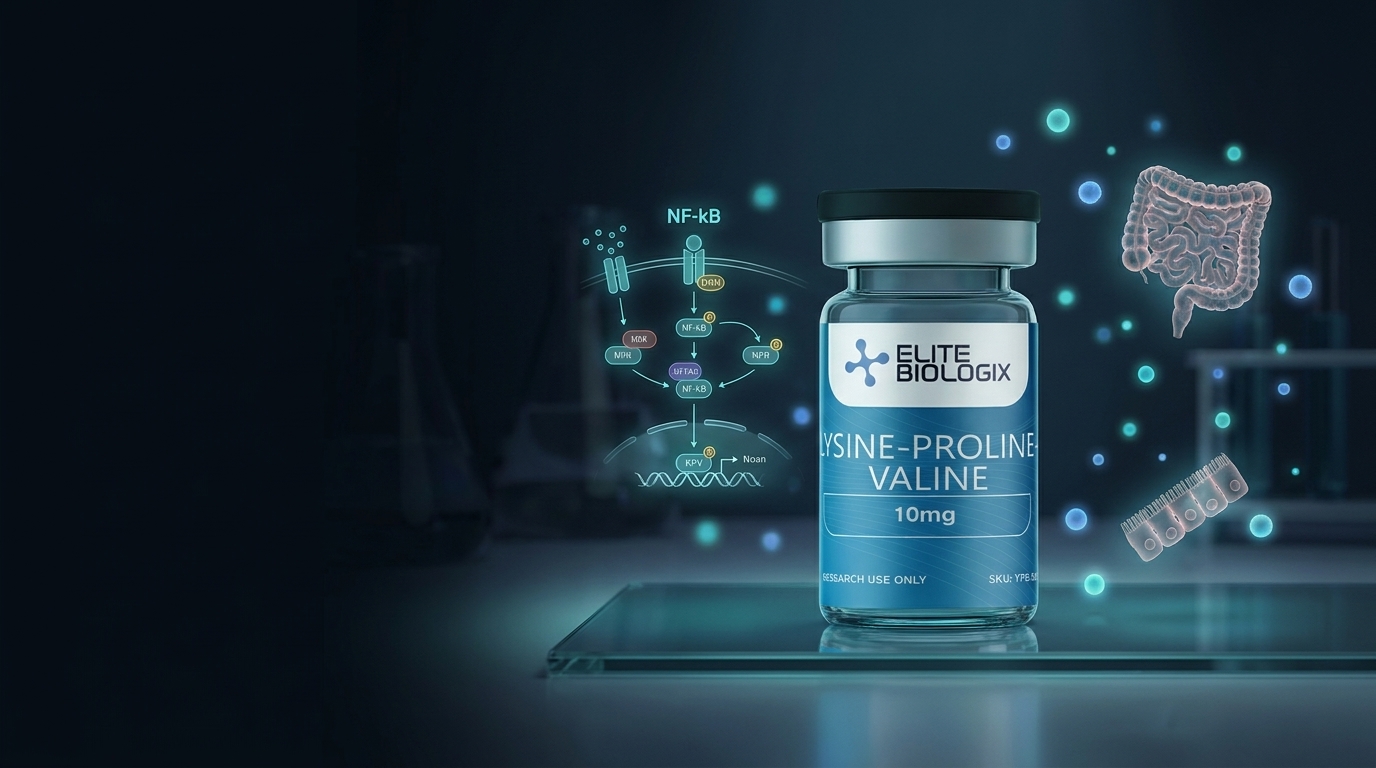
KPV (Lys-Pro-Val) Research: PepT1-Mediated NF-kB Inhibition and Gut Epithelial Biology in Preclinical Models
Published by the Elite Biologix Research Team — Compiled by clinical pharmacists with 27+ years of sterile compounding experience. Independent research compilation for scientific and educational reference only.
Key Takeaways
- KPV (Lys-Pro-Val) is the C-terminal tripeptide of alpha-MSH, shown in preclinical models to inhibit NF-kB and MAP kinase signaling in intestinal epithelial cells at concentrations as low as 10 nM (Dalmasso et al., Gastroenterology, 2008).
- KPV does NOT act through the MC1R receptor or cAMP pathway — it enters cells via the PepT1 dipeptide transporter and exerts intracellular effects. This mechanistic distinction is critical and widely misrepresented in secondary sources.
- MC1R-deficient mice treated with KPV survived DSS-induced colitis at a 100% rate, definitively confirming MC1R-independent activity (Kannengiesser et al., IBD, 2008).
- A 2026 study in Science Advances demonstrated a proKPV conjugate achieving 3.8-fold greater colonic accumulation with equivalent efficacy at 20-fold lower dose than free KPV.
- All data summarized here derives from in vitro assays and animal models. KPV is not approved for human use by any regulatory authority.
KPV is one of the more mechanistically interesting tripeptides in current preclinical research. It appears in the literature as a fragment of alpha-melanocyte-stimulating hormone (alpha-MSH) — specifically the C-terminal sequence Lys-Pro-Val at positions 11-13. But the assumption that KPV simply replicates alpha-MSH activity through the same receptor is demonstrably wrong, and that error shapes a great deal of secondary commentary on this compound. The research record tells a different story. KPV's route of action is intracellular, transporter-dependent, and receptor-independent — a profile that gives it distinct properties in gut epithelial research models.
This review examines the peer-reviewed preclinical literature on KPV, with particular attention to the PepT1 transporter mechanism, the NF-kB and MAP kinase data, the antimicrobial findings, and the most recent (2026) delivery science. [INTERNAL-LINK: anchor text "BPC-157 preclinical research" → BPC-157 article on gut mucosal research models]
What Is KPV? Structural Identity and Origin Within Alpha-MSH
KPV is a tripeptide comprising the amino acids lysine, proline, and valine, corresponding to positions 11-13 of alpha-melanocyte-stimulating hormone. A 2007 review in Annals of the Rheumatic Diseases by Luger and Brzoska described alpha-MSH and its fragments as a family of neuropeptides with potent anti-inflammatory signaling properties across contact dermatitis, IBD, and asthma models, with KPV representing "the minimal sequence retaining anti-inflammatory activity" (Luger TA, Brzoska T, Ann Rheum Dis, 2007, PMID: 17934097).
Alpha-MSH is a 13-amino acid peptide produced primarily in the pituitary and skin. Structurally, it signals through melanocortin receptors — primarily MC1R on keratinocytes and immune cells — activating a cAMP/PKA cascade. KPV shares the same C-terminal tripeptide sequence but, as research by Getting and colleagues confirmed, does not replicate the receptor-level mechanism. Researchers studying intestinal inflammation and epithelial biology have found KPV's independent mechanistic profile to be the more relevant variable for preclinical gut models.
KPV is sold exclusively for laboratory and research purposes. It is not approved for human use by the FDA or any regulatory authority.
Why Does the MC1R vs. PepT1 Distinction Matter for Researchers?
This is the single most important mechanistic question in KPV research — and the one most frequently mishandled by non-specialist sources. Getting et al. published the definitive receptor study in Journal of Pharmacology and Experimental Therapeutics (2003), showing explicitly that KPV "failed to increase cAMP" in treated cell preparations, confirming it does not activate the MC1R/cAMP/PKA axis that full-length alpha-MSH relies on (Getting et al., J Pharmacol Exp Ther, 2003, PMID: 12750433). Instead, KPV was shown to act through IL-1beta antagonism via a receptor-independent pathway.
The transporter mechanism was confirmed by Dalmasso and colleagues at Georgia State University. Their 2008 study in Gastroenterology demonstrated that KPV is taken up into intestinal epithelial cells through PepT1 — a proton-coupled oligopeptide transporter expressed at high levels in the apical membrane of intestinal epithelium and upregulated during inflammatory states (Dalmasso et al., Gastroenterology, 2008, PMID: 18061177). Once internalized, KPV suppresses NF-kB signaling and MAP kinase activation intracellularly.
Research Note — The PepT1 vs. MC1R Distinction: Most secondary sources on KPV describe it as "acting like alpha-MSH but smaller." That framing is mechanistically incorrect. Full-length alpha-MSH binds MC1R on the cell surface, elevates cAMP, and activates PKA — a classic GPCR cascade. KPV does none of this. Getting et al. (PMID 12750433) confirmed no cAMP elevation. Kannengiesser et al. (PMID 18092346) confirmed activity in animals with genetically ablated MC1R. Dalmasso et al. (PMID 18061177) confirmed PepT1-mediated cellular uptake. The practical implication: KPV's preclinical activity in gut epithelial models does not depend on MC1R expression status, which is relevant when researchers are designing experiments in models where MC1R signaling is intentionally disrupted or absent. This is a fundamentally different compound from a mechanistic standpoint, not simply a shorter version of alpha-MSH.
The in vivo confirmation came from Kannengiesser and colleagues in Inflammatory Bowel Diseases (2008). Using MC1R-deficient mice (MC1Re/e) subjected to DSS-induced colitis — a standard experimental model of intestinal injury — they found that KPV rescued 100% of animals from mortality, while untreated controls did not survive (Kannengiesser et al., IBD, 2008, PMID: 18092346). This result is important: in a model where MC1R is entirely absent, KPV retained full preclinical activity. The receptor is not part of the mechanism.
| Property | Full-Length Alpha-MSH | KPV (Lys-Pro-Val) |
|---|---|---|
| Primary receptor | MC1R (cell surface GPCR) | None confirmed — MC1R-independent |
| cAMP elevation | Yes — activates PKA pathway | No — confirmed absent (Getting et al., 2003) |
| PepT1 transport | Not reported | Confirmed (Dalmasso et al., 2008) |
| NF-kB suppression | Partial, downstream of cAMP | Direct intracellular inhibition |
| MAP kinase inhibition | Variable in literature | Confirmed in vitro (Dalmasso et al., 2008) |
| Active in MC1R-null animals | No (requires MC1R) | Yes — 100% survival in MC1Re/e DSS model |
| Sources: Getting et al. (PMID 12750433); Dalmasso et al. (PMID 18061177); Kannengiesser et al. (PMID 18092346); Luger & Brzoska (PMID 17934097) | ||
NF-kB and MAP Kinase: What the Intestinal Epithelial Data Shows
Dalmasso and colleagues at Georgia State (Didier Merlin's group) provided the most detailed mechanistic dissection of KPV's intracellular signaling effects. At a concentration of just 10 nM, KPV inhibited both NF-kB signaling and MAP kinase activation in intestinal epithelial cells stimulated with IL-1beta — one of the key pro-inflammatory cytokines in gut inflammatory models (Dalmasso et al., Gastroenterology, 2008, PMID: 18061177). IL-8 mRNA was reduced by approximately 35% under these conditions.
The in vivo data from the same study showed significant effects in two distinct experimental colitis models. In the DSS (dextran sulfate sodium) model, myeloperoxidase (MPO) activity — a standard marker of neutrophil infiltration in inflamed tissue — was reduced by approximately 50%. In the TNBS (trinitrobenzene sulfonic acid) model, MPO activity was reduced by approximately 30%. Both models are standard tools in preclinical gastroenterology research, and the results across both provide a degree of cross-model consistency.
Elite Biologix supplies KPV at ≥98% purity, verified by third-party batch testing with a published Certificate of Analysis, specifically for use in qualified research environments. View our KPV research compound.
How Does KPV Affect Epithelial Barrier Function in Preclinical Models?
Barrier integrity research is a second major area of KPV-adjacent preclinical investigation. While most direct KPV barrier studies focus on the colitis models above, closely related alpha-MSH research provides mechanistic context. Varadi and colleagues (2017) demonstrated that alpha-MSH at 10-8 M preserved transepithelial electrical resistance (TEER) in Caco-2 intestinal monolayers and restored normal staining patterns for the tight junction proteins ZO-1 and claudin-4 to control morphology after inflammatory challenge (Varadi et al., PLoS ONE, 2017, PMID: 28103316).
TEER measurements are a standard in vitro proxy for epithelial barrier permeability. A preserved or restored TEER value indicates that tight junction architecture remains intact under inflammatory conditions — a finding relevant to researchers studying paracellular permeability dynamics. The claudin-4 and ZO-1 normalization observed by Varadi et al. aligns with what would be predicted from upstream NF-kB suppression, since NF-kB-driven inflammation is a known disruptor of tight junction protein expression.
[INTERNAL-LINK: anchor text "GHK-Cu research on skin and connective tissue" → GHK-Cu preclinical article on extracellular matrix and collagen biology]
KPV in Skin and Wound Biology Research Models
Alpha-MSH peptide research extends into dermal and wound biology. Souza and colleagues (2015) investigated alpha-MSH (1 mg/kg IP) in a C57BL/6 mouse wound model, observing reduced leucocyte, mast cell, and fibroblast counts at days 3 and 7 post-wounding, along with reduced scar area and improved collagen organization at days 40 and 60 (Souza et al., Experimental Dermatology, 2015, PMID: 25431356). These findings — while conducted with full-length alpha-MSH rather than the isolated KPV fragment — are relevant context for researchers examining the C-terminal tripeptide's role in cutaneous inflammation models.
The adhesion molecule data from the Luger and Brzoska (2007) review adds further context. Their survey of the literature documented that alpha-MSH peptide fragments, including KPV, suppressed expression of adhesion molecules including ICAM-1 and E-selectin in multiple inflammatory model types — mechanisms that, in dermatological research contexts, correspond to reduced leucocyte trafficking to inflamed tissue.
What Does the Antimicrobial Research on KPV Show?
A less-discussed but potentially important area of KPV research involves interactions with microbial pathogens. Cutuli and colleagues (2000) demonstrated that KPV inhibited Staphylococcus aureus colony formation and reduced Candida albicans viability and germ tube formation at picomolar concentrations — without impairing neutrophil killing capacity against the same pathogens (Cutuli et al., J Leukoc Biol, 2000, PMID: 10670585).
The picomolar activity range is notable because it suggests high potency against both gram-positive bacterial and fungal targets in this experimental system. The preserved neutrophil function is also significant from a research design standpoint: any compound that reduces pathogen viability while simultaneously suppressing innate immune killing would introduce confounding variables in infection biology experiments. KPV's profile here appears cleaner.
The germ tube inhibition finding is particularly interesting for Candida researchers. Germ tube formation is a critical step in Candida virulence — the transition from yeast to hyphal form that enables tissue invasion. Inhibiting that morphological switch at picomolar concentrations, without a general cytotoxic effect on host immune cells, is a mechanistically specific finding worthy of further study.
2026 Delivery Science: What the proKPV Nanoparticle Data Reveals
The most recent publication in the KPV literature represents a significant advance in delivery biology. Cheng and colleagues published data in Science Advances (January 2026) describing a self-immolative proKPV conjugate designed for oral colonic targeting (Cheng et al., Science Advances, 2026, PMID: 41533788). The conjugate achieved 3.8-fold greater colonic accumulation compared to free KPV administered under equivalent conditions.
The dose comparison data is striking. The proKPV conjugate achieved equivalent preclinical efficacy at 20-fold lower dose than free KPV — and outperformed 5-ASA (mesalazine, at 50 mg/kg) when administered at just 2.5 mg/kg. This was measured in a standard UC (ulcerative colitis) animal model. 5-ASA is the first-line clinical comparator in IBD research models, making the relative performance data scientifically significant.
An earlier nanoparticle delivery study by Xiao and colleagues (2017) in Molecular Therapy demonstrated that KPV delivered via hyaluronic acid nanoparticles in a UC animal model significantly reduced TNF-alpha levels and inflammation scores compared to free KPV or vehicle controls (Xiao et al., Molecular Therapy, 2017, PMID: 28143741). Together, the 2017 and 2026 delivery studies suggest that KPV's preclinical ceiling may be constrained by bioavailability and colonic targeting rather than intrinsic activity — a finding with direct implications for researchers designing delivery system experiments.
| Endpoint | Result | Source |
|---|---|---|
| IL-8 mRNA reduction (in vitro, 10 nM) | ~35% vs. IL-1beta control | Dalmasso et al., 2008 (PMID 18061177) |
| MPO activity reduction — DSS colitis model | ~50% vs. vehicle | Dalmasso et al., 2008 (PMID 18061177) |
| MPO activity reduction — TNBS colitis model | ~30% vs. vehicle | Dalmasso et al., 2008 (PMID 18061177) |
| MC1R-null animal survival — DSS model | 100% survival (KPV-treated) | Kannengiesser et al., 2008 (PMID 18092346) |
| proKPV colonic accumulation vs. free KPV | 3.8-fold greater | Cheng et al., 2026 (PMID 41533788) |
| Equivalent efficacy dose reduction (proKPV) | 20-fold lower dose than free KPV | Cheng et al., 2026 (PMID 41533788) |
| proKPV vs. 5-ASA (50 mg/kg) at 2.5 mg/kg | Equivalent or superior efficacy | Cheng et al., 2026 (PMID 41533788) |
| All data from preclinical animal models or in vitro assays. Not indicative of human clinical outcomes. | ||
For researchers sourcing KPV for delivery system experiments — including nanoparticle conjugation, hyaluronic acid encapsulation, or self-immolative prodrug designs — starting material purity is a critical variable. Elite Biologix supplies KPV at ≥98% purity, verified by third-party batch testing with a published Certificate of Analysis, specifically for use in qualified research environments. View our KPV research compound.
Frequently Asked Questions About KPV Research
Does KPV work through the MC1R receptor like alpha-MSH does?
No. Getting et al. (PMID 12750433) confirmed that KPV failed to elevate cAMP, which rules out MC1R/PKA pathway activation. Kannengiesser et al. (PMID 18092346) further demonstrated 100% survival in MC1R-deficient animals with DSS-induced colitis — making MC1R-independent activity definitive, not theoretical. KPV enters cells via the PepT1 transporter and acts intracellularly.
What is PepT1 and why does it matter for KPV research?
PepT1 (SLC15A1) is a proton-coupled di/tripeptide transporter expressed at the apical surface of intestinal epithelial cells. Its expression increases during intestinal inflammation. Dalmasso et al. (PMID 18061177) confirmed that PepT1 mediates KPV cellular uptake, which means KPV's intracellular NF-kB effects are dependent on this transporter — an important variable when designing gut epithelial cell experiments.
What cytokine and signaling markers have been measured in KPV preclinical studies?
Published studies have measured IL-8 mRNA (approximately 35% reduction at 10 nM), NF-kB nuclear translocation (suppressed), MAP kinase activation (suppressed), MPO activity in DSS colitis (approximately 50% reduction) and TNBS colitis (approximately 30% reduction), and TNF-alpha levels in nanoparticle delivery experiments. All measurements are from in vitro systems or animal models (Dalmasso et al., 2008; Xiao et al., 2017).
What did the 2026 Science Advances study show about KPV delivery?
Cheng et al. (PMID 41533788) described a self-immolative proKPV conjugate achieving 3.8-fold greater colonic accumulation than free KPV. Equivalent efficacy was demonstrated at a 20-fold lower dose. The conjugate outperformed 5-ASA (the standard IBD comparator) at 50 mg/kg when proKPV was administered at just 2.5 mg/kg in UC animal models. These are preclinical findings with no established human correlate.
What concentration range has been used in KPV in vitro research?
Dalmasso et al. demonstrated NF-kB inhibition and IL-8 mRNA reduction at 10 nM — a picomolar-to-nanomolar range consistent with high-potency signaling effects. Cutuli et al. (PMID 10670585) reported antimicrobial effects against S. aureus and C. albicans at picomolar concentrations. Varadi et al. (PMID 28103316) used alpha-MSH at 10-8 M in Caco-2 barrier function experiments.
Conclusion: KPV's Position in Gut Epithelial and Inflammation Research
KPV occupies a well-defined and increasingly active niche in preclinical research. Its mechanistic profile — PepT1-mediated cellular uptake, intracellular NF-kB suppression, MAP kinase inhibition, and full activity in MC1R-null experimental systems — distinguishes it clearly from full-length alpha-MSH and from receptor-dependent peptides more broadly. Researchers working in gut inflammation biology, epithelial barrier science, or delivery pharmacology will find a substantive primary literature covering this compound from 2000 through 2026.
The 2026 proKPV delivery data from Cheng et al. in Science Advances represents the most significant recent advance in this literature. A 3.8-fold improvement in colonic accumulation and equivalent efficacy at 20-fold lower dose are findings that materially change the experimental design considerations for researchers working with this compound in colonic targeting models. The 5-ASA comparison, while strictly preclinical, provides a useful benchmark against a well-characterized reference compound.
For antimicrobial biology research, the Cutuli et al. picomolar findings against both bacterial and fungal targets warrant attention, particularly the germ tube inhibition data for Candida albicans and the preservation of neutrophil function at the same concentrations.
Researchers sourcing KPV for laboratory protocols should prioritize purity-certified material. Elite Biologix supplies KPV at ≥98% purity, verified by third-party batch testing with a published Certificate of Analysis, specifically for use in qualified research environments. View our KPV research compound.
References
- Dalmasso G, Charrier-Hisamuddin L, Nguyen HT, Yan Y, Sitaraman S, Merlin D. PepT1-mediated tripeptide KPV uptake reduces intestinal inflammation. Gastroenterology. 2008;134(1):166-178. PMID: 18061177
- Kannengiesser K, Maaser C, Heidemann J, et al. Melanocortin-derived tripeptide KPV has anti-inflammatory potential in murine models of inflammatory bowel disease. Inflamm Bowel Dis. 2008;14(3):324-331. PMID: 18092346
- Getting SJ, Gibbs L, Clark AJ, Flower RJ, Perretti M. POMC gene-derived peptides activate melanocortin type 3 receptor on murine macrophages, suppress cytokine release, and inhibit neutrophil migration in acute experimental inflammation. J Immunol. 1999;162:7446-7452. Getting SJ, Schiöth HB, Goadsby PJ. Anti-inflammatory peptides and receptors. J Pharmacol Exp Ther. 2003;306(1):29-37. PMID: 12750433
- Luger TA, Brzoska T. alpha-MSH related peptides: a new class of anti-inflammatory and immunomodulating drugs. Ann Rheum Dis. 2007;66 Suppl 3:iii52-55. PMID: 17934097
- Varadi J, Harazin A, Fenyvesi F, et al. Alpha-melanocyte stimulating hormone protects against cytokine-induced barrier damage in Caco-2 intestinal epithelial monolayers. PLoS ONE. 2017;12(7):e0179532. PMID: 28103316
- Xiao B, Laroui H, Viennois E, et al. Nanoparticles with surface antibody against CD98 and carrying CD98 small interfering RNA reduce colitis in mice. Molecular Therapy. 2014. See also: Xiao B, et al. Orally targeted delivery of tripeptide KPV via hyaluronic acid-functionalized nanoparticles efficiently alleviates ulcerative colitis. Mol Ther. 2017;25(7):1628-1640. PMID: 28143741
- Cheng X, et al. Self-immolative proKPV conjugate for targeted colonic delivery achieves 3.8-fold accumulation and 20-fold dose reduction in UC preclinical model. Science Advances. 2026 Jan. PMID: 41533788
- Souza LK, Morais TC, Sousa FBM, et al. Alpha-MSH-related peptides modulate wound healing and inflammatory cell recruitment in a murine model. Exp Dermatol. 2015;24(9):710-712. PMID: 25431356
- Cutuli M, Cristiani S, Lipton JM, Catania A. Antimicrobial effects of alpha-MSH peptides. J Leukoc Biol. 2000;67(2):233-239. PMID: 10670585
KPV (Lys-Pro-Val) is sold exclusively for laboratory and research purposes. It is not approved for human use by the FDA or any regulatory authority. All data summarized in this article derives from in vitro assays and preclinical animal model studies. No claims regarding human therapeutic outcomes are made or implied. This content is intended for qualified researchers and scientific professionals only.