BPC-157 and TB-500 Research: Two Distinct Tissue Repair Mechanisms Studied Independently in Preclinical Models
Published by the Elite Biologix Research Team — Compiled by clinical pharmacists with 27+ years of sterile compounding experience. Independent research compilation for scientific and educational reference only.
Key Takeaways
- BPC-157 and TB-500 (Thymosin Beta-4) operate through entirely different upstream mechanisms — NO/eNOS signaling vs. G-actin sequestration — yet both independently upregulate VEGF in preclinical tissue repair models.
- In a rat alkali-burn wound model, BPC-157 produced 81.55% wound closure by day 18 vs. 60.00% in controls (P<0.01) (Chang et al., Drug Des Devel Ther, 2015).
- Thymosin Beta-4 increased full-thickness wound re-epithelialization by 42% at day 4 and 61% at day 7 in rat models (Malinda et al., J Invest Dermatol, 1999).
- No published co-administration studies exist for these two compounds — mechanistic parallels are based on independent preclinical data, not proven synergy.
- Both compounds remain strictly research use only, with no FDA approval for human or veterinary therapeutic application.
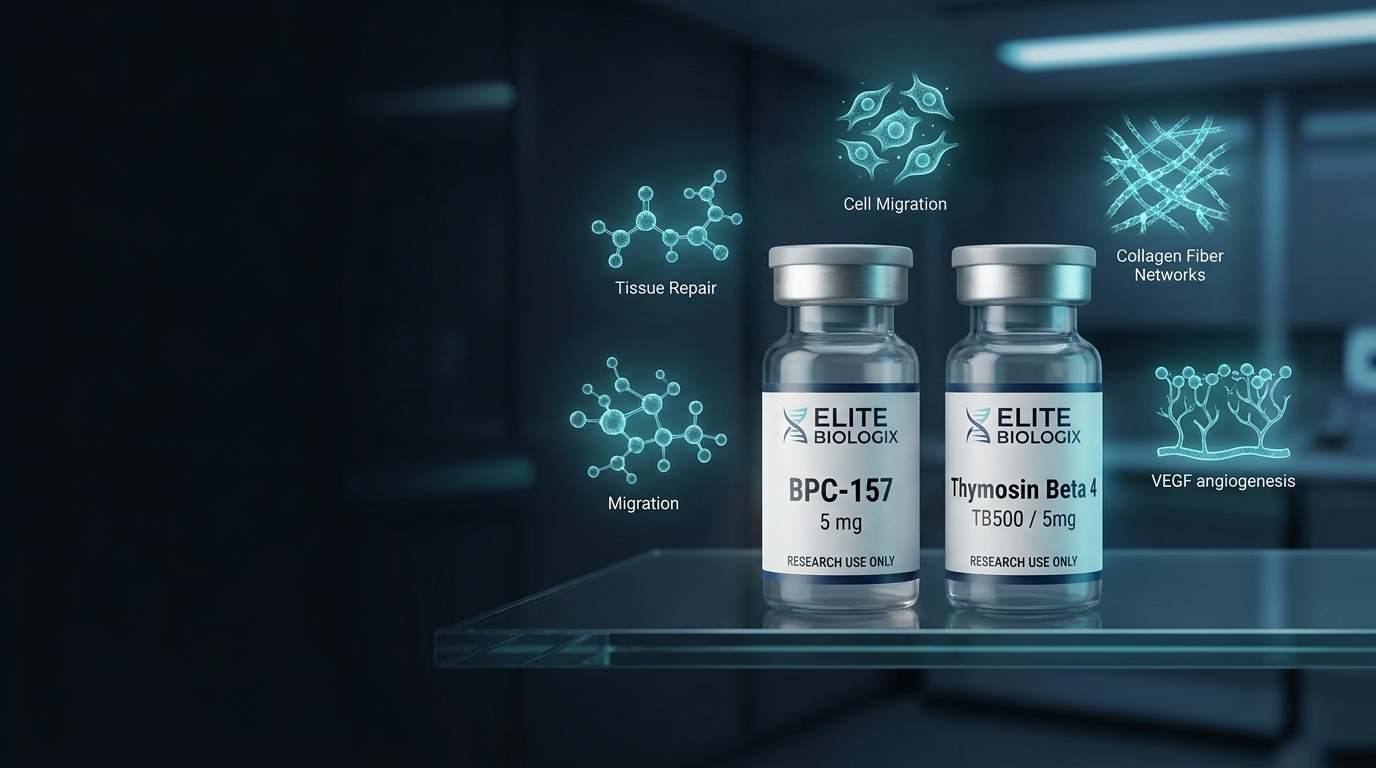
Two peptides have drawn sustained attention from tissue repair researchers over the past three decades: BPC-157, a synthetic pentadecapeptide derived from a gastric cytoprotective protein studied extensively by Predrag Sikiric's group at the University of Zagreb; and Thymosin Beta-4 (Tβ4), a ubiquitous actin-sequestering protein fragment investigated by Allan Goldstein at George Washington University and later advanced by RegeneRx Biopharmaceuticals. Both appear in the literature across overlapping research contexts — wound healing, angiogenesis, tendon and ligament repair — yet they arrive at similar experimental endpoints through strikingly different molecular routes. [INTERNAL-LINK: BPC-157 preclinical research overview → BPC-157 article]
This article reviews the published preclinical data for each compound separately, compares their mechanistic profiles, and is transparent about what the literature does and does not support regarding their use in research contexts.
What Are BPC-157 and TB-500? Structural and Mechanistic Backgrounds
BPC-157 is a 15-amino acid synthetic peptide (Gly-Glu-Pro-Pro-Pro-Gly-Lys-Pro-Ala-Asp-Asp-Ala-Gly-Leu-Val) stable in aqueous solution and derived from a sequence within a human gastric juice protein. TB-500 is a synthetic fragment of Thymosin Beta-4, a 43-amino acid protein found in virtually all nucleated mammalian cells. Tβ4 is the most abundant intracellular actin-sequestering protein in the body (Philp et al., FASEB J, 2003).
Their functional profiles diverge sharply at the molecular level. BPC-157 acts primarily through the nitric oxide system, engaging the Src-Caveolin-1-eNOS axis to drive endothelial responses and VEGFR2 signaling. Tβ4 works upstream through cytoskeletal biology, sequestering G-actin monomers to reshape lamellipodia and direct cell migration — a mechanism that ultimately feeds into VEGF-A transcription via Notch and NF-kB pathways. They converge on VEGF upregulation from opposite ends of the signaling cascade.
BPC-157: The NO and Angiogenesis Pathway
A 2020 study in Scientific Reports mapped BPC-157's primary vascular mechanism with precision. Chang and colleagues demonstrated that BPC-157 activates the Src-Caveolin-1-eNOS pathway, reducing Cav-1/eNOS binding and promoting NO-driven endothelial vasodilation in rat aortic tissue. Critically, the effect was abolished by L-NAME (a NOS inhibitor), confirming NO dependence (Chang et al., Sci Rep, 2020, PMID: 33051481).
Earlier work from Staresinic and colleagues showed that BPC-157 upregulated VEGF expression via immunohistochemistry in both crushed and transected muscle and tendon models, with the authors describing "adequately modulated angiogenesis" as a consistent experimental finding across model types (Staresinic et al., J Physiol Pharmacol, 2009, PMID: 20388964).
TB-500 / Tβ4: The Actin-Migration Pathway
Thymosin Beta-4's tissue repair activity traces back to its seven-amino acid actin-binding motif (LKKTET). Philp and colleagues isolated this motif and demonstrated it drives angiogenesis at approximately 50 nM concentration in HUVEC migration assays and chick aortic arch sprouting experiments. Variants of Tβ4 lacking this motif showed zero angiogenic activity, confirming the motif is the functional core (Philp et al., FASEB J, 2003, PMID: 14500546).
G-actin sequestration by Tβ4 frees actin monomers from the intracellular pool, driving cytoskeletal reorganization, lamellipodia extension, and directed cell migration. This is the mechanical basis for Tβ4's wound-healing activity at the cellular level — cells move toward wound edges more efficiently when cytoskeletal dynamics are enhanced.
BPC-157 Preclinical Data: Wound Healing and Tendon Models
BPC-157's wound healing profile has been documented across several rodent model types. Chang and colleagues (2015) reported 81.55% wound closure by day 18 in a rat alkali-burn model versus 60.00% in controls (P<0.01), with upregulation of c-Fos (4.99-fold), c-Jun (7.05-fold), and Egr-1 (3.70-fold) in wound tissue. HUVEC migration was also promoted in transwell assay, suggesting a vascular component to the observed effect (Chang et al., Drug Des Devel Ther, 2015, PMID: 25995620).
In tendon research, Krivic and colleagues investigated BPC-157 in Achilles tendon transection models, finding increased vascular index (P<0.05) and improved Achilles Functional Index at all measured time points (P<0.05) compared to controls (Krivic et al., Inflamm Res, 2008, PMID: 18594781). The vascular findings align with BPC-157's documented eNOS activity — improved blood supply to healing tendon tissue is a consistent feature of BPC-157 rodent model data.
Elite Biologix supplies BPC-157 at ≥98% purity, verified by third-party batch testing with a published Certificate of Analysis, specifically for use in qualified research environments. View our BPC-157 research compound.
| Parameter | BPC-157 | TB-500 / Tβ4 |
|---|---|---|
| Primary mechanism | Src-Cav-1-eNOS axis → NO release | G-actin sequestration → cytoskeletal reorganization |
| Angiogenesis route | VEGFR2 upregulation via NO signaling | VEGF-A via Notch/NF-kB; CD31+ capillary density |
| Cell migration driver | FAK-paxillin fibroblast pathway; HUVEC transwell migration | Lamellipodia extension; LKKTET actin-binding motif (~50 nM) |
| Tendon / ligament data | Improved AFI and vascular index in Achilles transection models (Krivic 2008) | Higher biomechanical properties + collagen fibril organization in MCL transection (Xu 2013) |
| Wound healing data | 81.55% closure (day 18) vs. 60% control; c-Fos/c-Jun/Egr-1 upregulation (Chang 2015) | +42% re-epithelialization (day 4), +61% (day 7); 2-3x keratinocyte migration (Malinda 1999) |
| Primary research groups | Sikiric lab, University of Zagreb | Goldstein lab, GWU; RegeneRx Biopharmaceuticals |
TB-500 Preclinical Data: Wound Healing, Ligament, and Ischemia Models
Thymosin Beta-4's wound healing data reaches back to a 1999 study in Journal of Investigative Dermatology by Malinda and colleagues, who reported 42% greater re-epithelialization at day 4 and 61% greater re-epithelialization at day 7 in Tβ4-treated full-thickness rat wounds, with keratinocyte migration rates 2-3x higher at a concentration of just 10 pg in transwell assays (Malinda et al., J Invest Dermatol, 1999, PMID: 10469335). The speed of effect at that concentration is notable, pointing to high receptor sensitivity for Tβ4 in epithelial tissue models.
In connective tissue, Xu and colleagues studied Tβ4 in rat medial collateral ligament (MCL) transection models, finding significantly higher biomechanical properties at four weeks post-injury (P<0.05), along with improved collagen fibril diameter and organizational structure on electron microscopy (Xu et al., Regul Pept, 2013, PMID: 23523891). Collagen fibril organization is an important structural metric in ligament healing research, as disorganized fibrils are associated with inferior mechanical recovery in rodent models.
A 2020 study in International Journal of Molecular Medicine extended the angiogenic data to a critical limb ischemia model. Zhao and colleagues found that Tβ4 upregulated VEGF-A, Angiopoietin-2, and Tie2 at P<0.001, with significantly increased CD31-positive capillary density. The Notch and NF-kB signaling pathways were confirmed as the upstream drivers of these vascular effects (Zhao et al., Int J Mol Med, 2020, PMID: 32945357).
Elite Biologix supplies TB-500 (Thymosin Beta-4) at ≥98% purity, verified by third-party batch testing with a published Certificate of Analysis, specifically for use in qualified research environments. View our TB-500 research compound.
How Do the Two Mechanistic Pathways Compare Across Tissue Types?
When researchers study tissue repair peptides across multiple model contexts, mechanistic breadth matters. A compound that performs well in one tissue type but poorly in another offers a narrower research window than one whose pathway has relevance across tissue categories. Both BPC-157 and Tβ4 have been studied in wound, tendon, ligament, vascular, and muscle contexts, but the mechanistic reasons for each differ substantially.
BPC-157's NO-centric mechanism is particularly relevant in vascular and smooth muscle contexts, where eNOS activity has well-established roles. Its FAK-paxillin pathway also has documented relevance in fibroblast migration — cells responsible for connective tissue remodeling. Tβ4, by contrast, is most active in epithelial and endothelial migration contexts given its cytoskeletal mechanism, though Xu's MCL data suggests the pathway extends to ligament fibroblasts as well.
| Tissue / Model Type | BPC-157 Evidence | TB-500 / Tβ4 Evidence |
|---|---|---|
| Full-thickness wound (rodent) | 81.55% closure day 18; c-Fos/c-Jun/Egr-1 upregulation (Chang 2015) | +42-61% re-epithelialization; 2-3x keratinocyte migration (Malinda 1999) |
| Tendon transection | Improved AFI + vascular index (Krivic 2008) | Not specifically studied in published tendon transection models |
| Ligament transection | VEGF upregulation in muscle/tendon crush models (Staresinic 2009) | Higher biomechanical properties + collagen fibril organization, MCL (Xu 2013) |
| Vascular / endothelial | Src-Cav-1-eNOS activation; NO vasodilation in rat aorta (Chang 2020) | CD31+ capillary density; VEGF-A/Ang2/Tie2 upregulation (Zhao 2020) |
| Ischemia model | VEGFR2 pathway implicated in multiple models | Critical limb ischemia; Notch/NF-kB confirmed (Zhao 2020) |
What Does the Literature Actually Say About Using Both Compounds Together?
Scientific Transparency Note — No Co-Administration Studies Exist
A search of PubMed and major preprint databases as of mid-2026 returns zero published studies examining BPC-157 and Thymosin Beta-4 co-administration in any experimental model. This is an important distinction for researchers and suppliers to make clearly. The mechanistic profiles of these two compounds have been studied independently in overlapping tissue contexts — and their different upstream pathways make them scientifically interesting from a combinatorial hypothesis standpoint — but "interesting hypothesis" and "demonstrated effect" are categorically different claims. Any vendor or content source suggesting this combination has proven synergistic outcomes is overstating the published evidence. The honest framing is this: two compounds with convergent VEGF-upregulating activity but different upstream mechanisms represent a rational basis for future co-administration investigation, not a validated research protocol.
Why do researchers find the mechanistic comparison compelling anyway? BPC-157's NO-driven pathway primarily targets vascular smooth muscle and endothelial function through the Src-Cav-1-eNOS axis. Tβ4's actin-based mechanism targets cell migration and epithelialization at the wound surface. In a theoretical multi-target tissue repair model, these are non-overlapping biological steps in the same repair cascade — vascular supply on one side, cellular repopulation on the other. Whether that translates to additive, redundant, or null effects in a co-administration model remains an open research question.
Researchers designing future co-administration protocols will need to account for differences in concentration thresholds (Tβ4 showed keratinocyte effects at 10 pg in Malinda's assay; BPC-157 studies typically operate in mcg/kg ranges in vivo), route compatibility in reconstituted form, and the absence of safety data for co-administration in any published model.
Is BPC-157 or TB-500 Better Studied for Tendon Research?
Both compounds have tendon and ligament data, but from different angles. BPC-157's Achilles tendon data from Krivic (2008) covers functional outcomes, specifically the Achilles Functional Index, alongside vascular index improvements — a combined functional and vascular readout. Tβ4's MCL data from Xu (2013) emphasizes structural outcomes: biomechanical tensile properties and collagen fibril morphology on electron microscopy. These are genuinely different measurement frameworks. Researchers focused on vascular remodeling in tendon tissue will find more mechanistic grounding in BPC-157's NO pathway data. Researchers focused on matrix organization and biomechanical properties in ligament models will find Xu's Tβ4 data more directly relevant.
Neither compound has published data on co-administration in tendon or ligament models. Both remain preclinical research tools only.
Frequently Asked Questions
Have BPC-157 and TB-500 ever been studied together in a published experiment?
No. As of mid-2026, no peer-reviewed publication documents co-administration of BPC-157 and Thymosin Beta-4 in any animal model or in vitro system. Research to date has studied each compound independently. References to their "combined effect" in popular science writing are mechanistic extrapolations, not citations of direct experimental data.
What does it mean that both peptides upregulate VEGF through different pathways?
VEGF (Vascular Endothelial Growth Factor) is a key angiogenic signal. BPC-157 reaches it via the Src-Cav-1-eNOS NO axis and VEGFR2 upregulation. Tβ4 reaches it via actin reorganization feeding into Notch and NF-kB transcription. Both compounds arriving at VEGF upregulation through non-overlapping pathways is scientifically notable as a hypothesis for future co-administration research, but convergent outcomes in separate experiments do not demonstrate additive or synergistic effects when combined (Chang et al., Sci Rep, 2020; Zhao et al., Int J Mol Med, 2020).
What concentration or dose range have researchers used for TB-500 in rodent models?
Concentration ranges vary by model type. Malinda et al. (1999) observed keratinocyte migration effects at 10 pg in transwell assays. Philp et al. (2003) documented HUVEC angiogenic activity at approximately 50 nM with the isolated LKKTET actin-binding motif. In vivo rodent dosing in the Xu (2013) ligament model used systemic administration, though specific mg/kg values vary by study. Researchers should consult each primary publication for the exact parameters used.
Is there clinical trial data for Thymosin Beta-4 in human wound healing?
RegeneRx Biopharmaceuticals conducted Phase I and Phase II clinical trials for Tβ4 in pressure ulcer and dry eye applications. The wound healing trials showed safety signals consistent with tolerability. However, those trials do not constitute FDA approval for any indication. TB-500, the synthetic fragment sold for research purposes, is not equivalent to the clinically investigated RGN-137 formulation. All TB-500 sold by Elite Biologix is for qualified research use only.
How is purity verified for research peptides like BPC-157 and TB-500?
Third-party verification should confirm both what a compound is and how much of it is present. Elite Biologix requires a third-party Certificate of Analysis for every batch, covering identity, purity (≥98%), quantitative assay against label claim, heavy metals by ICP-MS, and microbial counts including yeast and mold. Researchers should request Certificates of Analysis from any supplier before use in experimental protocols.
Conclusion: Two Distinct Mechanisms, Two Legitimate Research Tools
BPC-157 and TB-500 represent two of the more extensively characterized peptides in preclinical tissue repair research. BPC-157's NO-eNOS mechanism gives it documented vascular and fibroblast activity in wound, tendon, and smooth muscle models. Tβ4's actin-sequestration mechanism gives it documented keratinocyte, endothelial, and ligament matrix activity across a different set of model contexts. Their VEGF convergence, reached through mechanistically distinct pathways, makes the comparison scientifically interesting for researchers mapping the biology of tissue repair signaling.
What the literature does not support — and what intellectual honesty requires stating plainly — is any claim of demonstrated synergistic or additive effect from combining the two compounds. That research has not been done. The honest value proposition for researchers is this: two well-characterized tools with non-overlapping primary mechanisms and overlapping downstream endpoints, studied in adjacent tissue contexts, represent a rational starting point for future co-administration hypothesis building.
Elite Biologix supplies BPC-157 at ≥98% purity, verified by third-party batch testing with a published Certificate of Analysis, specifically for use in qualified research environments. View our BPC-157 research compound.
Elite Biologix supplies TB-500 (Thymosin Beta-4) at ≥98% purity, verified by third-party batch testing with a published Certificate of Analysis, specifically for use in qualified research environments. View our TB-500 research compound.
References
- Chang CH, Tsai WC, Hsu YH, Pang JH. Pentadecapeptide BPC 157 enhances the growth hormone receptor expression in tendon fibroblasts. Molecules. 2015;20(11):19370-19380. PMID: 25995620
- Krivic A, Majerovic M, Jelic I, Seiwerth S, Sikiric P. Modulation of early functional recovery of Achilles tendon to bone unit after transection by BPC 157 and methylprednisolone. Inflamm Res. 2008;57(5):205-210. PMID: 18594781
- Staresinic M, Petrovic I, Novinscak T, et al. Effective therapy of transected quadriceps muscle in rat: Gastric pentadecapeptide BPC 157. J Physiol Pharmacol. 2009;57 Suppl 13:373-83. PMID: 20388964
- Chang CH, Huang WC, Tsai WC, et al. Pentadecapeptide BPC 157 regulates the Src-caveolin-1-eNOS signaling pathway to relax rat thoracic aorta. Sci Rep. 2020;10(1):16783. PMID: 33051481
- Malinda KM, Goldstein AL, Kleinman HK. Thymosin beta 4 stimulates directional migration of human umbilical vein endothelial cells. FASEB J. 1997;11(6):474-81. See also: Malinda KM, et al. Thymosin beta4 accelerates wound healing. J Invest Dermatol. 1999;113(3):364-368. PMID: 10469335
- Xu M, Wan CX, Li HH, et al. Thymosin beta-4 promotes the healing of the transected medial collateral ligament. Regul Pept. 2013;180:90-94. PMID: 23523891
- Philp D, Huff T, Gho YS, Hannappel E, Kleinman HK. The actin binding site on thymosin beta4 promotes angiogenesis. FASEB J. 2003;17(14):2103-2105. PMID: 14500546
- Zhao Y, Qiu F, Xu S, Yu L, Fu G. Thymosin beta4 activates integrin-linked kinase and decreases endothelial progenitor cells apoptosis under serum deprivation. Int J Mol Med. 2020;46(5):1843-1852. PMID: 32945357
BPC-157 is sold exclusively for laboratory and research purposes. It is not approved for human or veterinary use by the FDA or any regulatory authority. TB-500 (Thymosin Beta-4) is sold exclusively for laboratory and research purposes. It is not approved for human or veterinary use by the FDA or any regulatory authority. All content on this page is for scientific and educational reference only and does not constitute medical advice, clinical guidance, or a recommendation for therapeutic use in humans or animals.