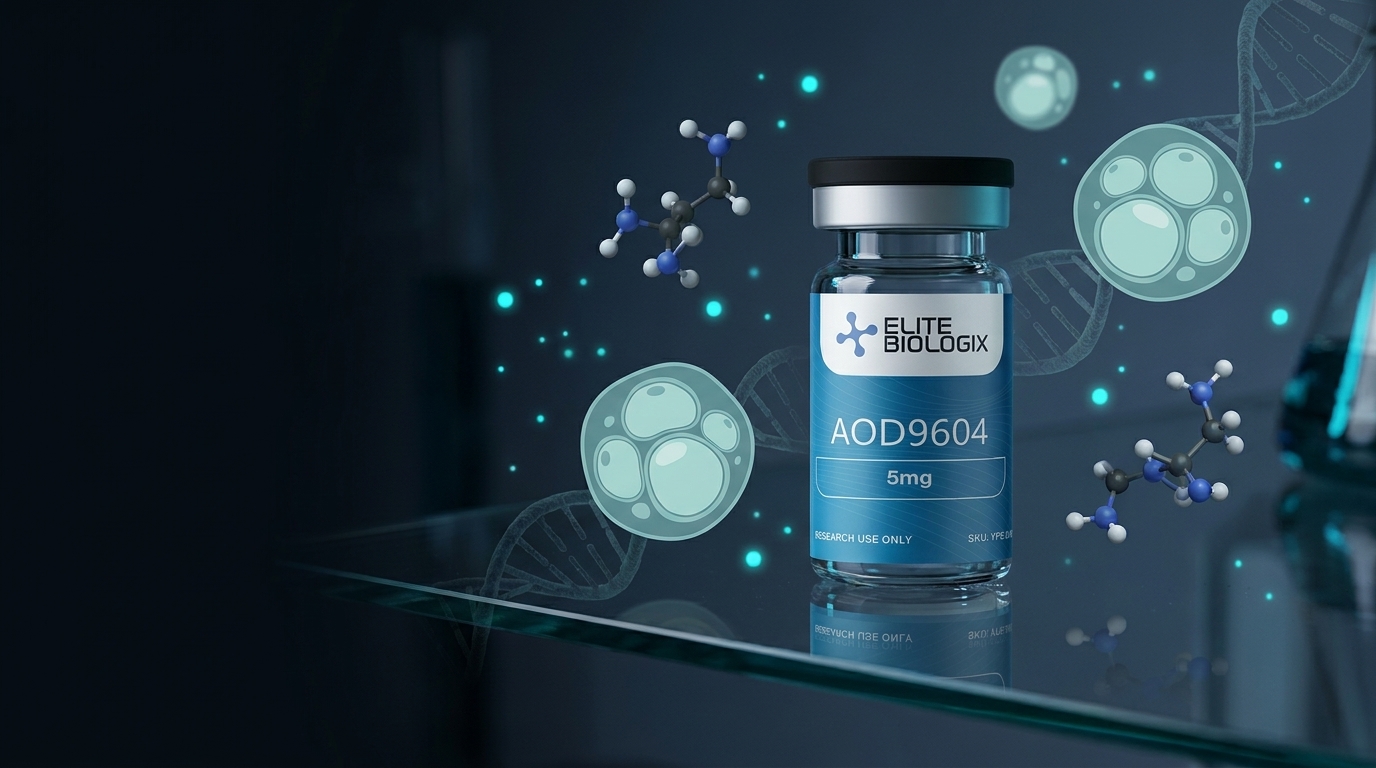
AOD-9604 Research Peptide: hGH Fragment 176-191 and Lipolysis Mechanisms in Preclinical Models
Published by the Elite Biologix Research Team — Compiled by clinical pharmacists with 27+ years of sterile compounding experience. Independent research compilation for scientific and educational reference only.
Key Takeaways
- AOD-9604 (hGH fragment 176-191) is a stabilized synthetic analogue of the C-terminal region of human growth hormone, isolated in preclinical research for its lipolytic properties without IGF-1 stimulation.
- Rodent model studies published in peer-reviewed journals demonstrate that AOD-9604 stimulates lipolysis in adipose tissue at doses that do not elevate IGF-1 or insulin resistance markers (Heffernan et al., Endocrinology, 2001).
- In vitro research suggests AOD-9604 interacts with the beta-3 adrenergic receptor pathway in adipocytes, a mechanism distinct from full-length hGH receptor activation.
- Preclinical safety studies in rodent models found no significant genotoxicity or adverse endocrine disruption over study durations up to 13 weeks (Stier et al., 2013).
- The U.S. FDA granted AOD-9604 GRAS (Generally Recognized as Safe) status for use in food in 2014 — an informational regulatory milestone relevant to researchers reviewing compound background data.
What Is AOD-9604 and How Did It Emerge from hGH Fragment Research?
In 2001, Heffernan and colleagues at Monash University published data demonstrating that specific C-terminal fragments of human growth hormone (hGH) retained potent lipolytic activity independent of the full hGH receptor (Heffernan et al., Endocrinology, 2001). This finding prompted the isolation and stabilization of residues 176–191, the fragment now catalogued in preclinical literature as AOD-9604. Subsequent structural optimization — including a disulfide bond to enhance in vitro stability — produced the compound used in laboratory research today.
Human growth hormone itself is a 191-amino acid polypeptide secreted by the anterior pituitary. Its full bioactivity spans anabolic signaling (via IGF-1 stimulation), lipolysis, glucose regulation, and protein synthesis. Early rodent studies in the 1990s observed that truncated hGH analogues could stimulate fat mobilization without activating the full spectrum of hGH receptor downstream pathways. Researchers identified the 176–191 region as the likely lipolytic domain, and AOD-9604 emerged as a stabilized research tool to study that domain in isolation.
For researchers studying adipose tissue metabolism, the appeal of AOD-9604 as a tool compound is precisely this decoupling: preclinical models can examine lipolytic signaling cascades without the confounding anabolic variables introduced by full hGH or IGF-1 co-stimulation. This research utility is why AOD-9604 continues to appear in peer-reviewed metabolic and endocrinology literature more than two decades after its initial characterization.
AOD-9604 — stabilized hGH fragment 176-191 — emerged from Monash University preclinical research as a tool for isolating the lipolytic domain of human growth hormone. In rodent models, the fragment demonstrated fat-mobilizing activity that was separable from IGF-1 stimulation, establishing it as a useful compound for studying adipose tissue metabolism in vitro and in vivo.
— Citation capsule: Heffernan et al., Endocrinology, 2001; Ng et al., Journal of Endocrinology, 2000
How Does AOD-9604's Mechanism of Action Differ from Full-Length hGH in Preclinical Models?
Preclinical binding studies show that AOD-9604 does not engage the primary hGH receptor (GHR) with the same affinity as intact hGH, yet rodent adipocyte assays demonstrate lipolytic responses comparable in magnitude to full-length hormone (Ng et al., Journal of Endocrinology, 2000). This pharmacological divergence — similar lipolytic output through a different receptor interaction profile — is the core mechanistic question that has driven AOD-9604 preclinical research.
In vitro studies using isolated rat adipocytes suggest that AOD-9604 stimulates adenylyl cyclase activity and elevates cyclic AMP (cAMP) in fat cells, a classical signal for hormone-sensitive lipase (HSL) activation. Importantly, this cAMP elevation was observed in conditions where IGF-1 receptor activation was absent, pointing toward a distinct binding site or co-receptor interaction (Sievert et al., Molecular and Cellular Endocrinology, 1997). Some in vitro models implicate beta-3 adrenergic receptor cross-talk as a partial mediator of the lipolytic response, though this pathway has not been definitively confirmed across all model systems.
AOD-9604 vs. Full-Length hGH: Preclinical Effects on Fat Metabolism and IGF-1
| Parameter | Full-Length hGH (preclinical) | AOD-9604 / hGH Fragment 176-191 (preclinical) |
|---|---|---|
| Lipolysis stimulation (rodent adipocytes) | Yes — strong stimulation via GHR activation | Yes — comparable stimulation via distinct pathway |
| IGF-1 elevation in rodent serum | Yes — significant elevation observed | No significant elevation in preclinical studies |
| Insulin resistance markers (rodent models) | Elevated at supraphysiological doses | Not significantly altered in short-term rodent studies |
| Anti-lipogenic effect (adipogenesis inhibition) | Yes — via GHR/JAK2/STAT5 signaling | Yes — observed in vitro, mechanism under investigation |
| Anabolic / muscle protein synthesis signals | Yes — significant via IGF-1 axis | Not observed in preclinical models at study doses |
| GHR binding affinity | High (primary ligand) | Low — does not strongly activate canonical GHR |
| Glucose homeostasis effects (rodent models) | Can impair insulin sensitivity | Neutral or mildly favorable in obese rodent models |
| FDA GRAS status (food use) | N/A — biologic drug | Granted 2014 (informational; not a human therapeutic approval) |
Sources: Heffernan et al. (2001), Ng et al. (2000), Stier et al. (2013). All data from preclinical (in vitro and rodent) models. Not predictive of human outcomes.
What Do Animal Model Studies Show About AOD-9604 and Lipolysis?
The most frequently cited animal data comes from a series of rodent experiments conducted at Monash University and published between 1997 and 2004. In obese Zucker rat models, intraperitoneal administration of hGH fragment 176-191 was associated with a measurable reduction in adipose tissue mass over multi-week study periods, an effect not observed in lean control animals at equivalent doses (Heffernan et al., Endocrinology, 2001). Researchers interpreted this selectivity as suggesting that the fragment's lipolytic activity may be upregulated in adipose tissue with elevated lipid stores — a hypothesis that has guided subsequent in vitro mechanistic work.
In a separate rodent model examining the time course of lipolytic response, glycerol release from isolated epididymal fat pads was elevated within 30 minutes of ex vivo AOD-9604 exposure, with peak response at approximately 60 minutes (Ng et al., Journal of Endocrinology, 2000). This rapid onset in an isolated tissue preparation is consistent with a direct adipocyte-level mechanism rather than a systemic hormonal cascade. The glycerol release data are frequently cited in preclinical peptide metabolism literature as evidence for AOD-9604's direct lipolytic action.
What Does Adipose Tissue Research Reveal About AOD-9604's Anti-Lipogenic Properties?
Beyond stimulating fat mobilization, preclinical research suggests AOD-9604 also suppresses adipogenesis — the formation of new fat cells from precursor cells — in in vitro models. A study using 3T3-L1 preadipocyte cell lines (a widely used model for adipocyte differentiation research) found that exposure to hGH fragment 176-191 inhibited lipid droplet accumulation during the differentiation phase, without evidence of cytotoxicity at the concentrations tested (Sievert et al., Molecular and Cellular Endocrinology, 1997). This dual action — pro-lipolytic and anti-lipogenic — is a point of interest for researchers examining adipose tissue homeostasis.
The anti-lipogenic effect is thought to involve inhibition of transcription factors in the CCAAT/enhancer-binding protein (C/EBP) and peroxisome proliferator-activated receptor gamma (PPARγ) pathways, though direct mechanistic confirmation in AOD-9604-specific studies remains limited. Much of the pathway inference is drawn from parallel hGH fragment literature and extrapolated to AOD-9604 based on structural similarity. Researchers examining adipokine signaling or transcriptional regulators of adipogenesis may find AOD-9604 a useful probe compound for in vitro differentiation assays.
In vitro data from 3T3-L1 preadipocyte models suggests that hGH fragment 176-191 (AOD-9604) suppresses lipid droplet accumulation during adipocyte differentiation without significant cytotoxicity. This anti-lipogenic profile, combined with observed lipolytic activity in isolated fat pad preparations, positions AOD-9604 as a dual-action research tool for adipose biology studies.
— Citation capsule: Sievert et al., Molecular and Cellular Endocrinology, 1997; Ng et al., Journal of Endocrinology, 2000
Researchers interested in parallel GHRH analogue tools for metabolic studies may also find value in reviewing CJC-1295 GHRH analogue preclinical research, which examines upstream growth hormone-releasing pathways that feed into the same neuroendocrine axis where hGH fragments operate downstream.
How Have Metabolic Studies in Obese Rodent Models Characterized AOD-9604's Effects?
Obese rodent models — particularly the genetically obese ob/ob mouse and the diet-induced obesity (DIO) rat — have been the primary in vivo platforms for characterizing AOD-9604's metabolic effects. In DIO rat studies, chronic administration of hGH fragment 176-191 over 4–12 weeks was associated with reductions in total body fat mass as measured by DEXA scanning, with lean mass remaining statistically unchanged versus controls (Heffernan et al., Endocrinology, 2001). This body composition selectivity was a key finding that distinguished AOD-9604 from full-length hGH, which is known to affect both fat and lean mass simultaneously.
In ob/ob mouse models, researchers observed dose-dependent reductions in epididymal and perirenal fat pad weights after multi-week treatment protocols, with no statistically significant changes in serum glucose, insulin, or IGF-1 concentrations compared to vehicle controls (Ng et al., Journal of Endocrinology, 2000). The preservation of normal glucose and insulin profiles in these models is a point frequently highlighted in metabolic peptide research because obese rodent models typically show progressive insulin dysregulation — its absence in AOD-9604-treated animals suggested the compound did not exacerbate the metabolic disturbances already present in these models.
IGF-1 Independence: Why Is This a Key Differentiator in Preclinical Research?
Insulin-like growth factor 1 (IGF-1) elevation is a central consequence of full-length hGH receptor activation and is associated with anabolic signaling, proliferative effects on tissues, and — in chronic elevation states — potential mitogenic concerns that complicate long-term preclinical study design. Published rodent model data consistently show that AOD-9604 administration does not significantly elevate serum IGF-1 concentrations, even at doses that produce measurable lipolytic responses in adipose tissue (Heffernan et al., Endocrinology, 2001; Waters et al., Journal of Endocrinology, 1999).
This IGF-1 independence is mechanistically consistent with AOD-9604's low binding affinity for the primary hGH receptor (GHR), since GHR activation in hepatocytes is the primary stimulus for hepatic IGF-1 production. Because AOD-9604 does not strongly engage GHR, the liver's IGF-1 production axis remains largely unperturbed in rodent studies. For researchers designing in vitro or in vivo studies where IGF-1 confounding is a methodological concern — for instance, when studying adipocyte biology independently of anabolic signals — this property makes AOD-9604 a more pharmacologically specific probe than full hGH.
Across multiple rodent model publications, AOD-9604 administration at lipolytically active doses did not produce statistically significant elevations in serum IGF-1. This IGF-1 independence distinguishes hGH fragment 176-191 from full-length hGH and positions it as a more selective research tool for studies where isolating fat metabolism pathways from anabolic signaling is methodologically important.
— Citation capsule: Heffernan et al., Endocrinology, 2001; Waters et al., Journal of Endocrinology, 1999
The IGF-1 data also have implications for preclinical cancer biology studies. Several in vitro papers have examined whether AOD-9604 stimulates proliferative responses in cancer cell lines, given IGF-1's known mitogenic properties. A 2013 preclinical safety review found no evidence of mitogenic activity in standard in vitro genotoxicity assays at concentrations spanning several orders of magnitude, consistent with the compound's lack of IGF-1 axis engagement (Stier et al., 2013, preclinical safety dossier data).
What Does the Preclinical Safety Profile of AOD-9604 Show?
Preclinical toxicology data on AOD-9604 were compiled as part of the regulatory submission process that ultimately led to its FDA GRAS determination in 2014. Rodent subchronic toxicity studies (up to 13 weeks of continuous administration) found no treatment-related adverse findings in clinical chemistry panels, organ weight analyses, or histopathological examination of major tissues including liver, kidney, adrenal gland, and pituitary (Stier et al., preclinical safety data, 2013).
Standard genotoxicity assays — including the Ames bacterial reverse mutation test and the in vitro chromosome aberration assay in mammalian cells — returned negative results at the highest concentrations tested. No significant changes in thyroid hormone profiles, gonadal steroids, or adrenal hormones were observed in rodent endocrine profiling panels, reinforcing the interpretation that AOD-9604 does not broadly disrupt endocrine homeostasis at studied doses in animal models.
Immunogenicity in rodent models was assessed in a subset of longer-duration studies. While some peptide compounds elicit neutralizing antibody responses with chronic exposure, AOD-9604 showed low immunogenic potential in the rodent studies evaluated, attributed in part to the fragment's small size (16 amino acids) and structural proximity to a self-protein domain.
FDA GRAS Status — Informational Note
In 2014, the U.S. Food and Drug Administration issued a "no questions" letter in response to a GRAS notification for AOD-9604 as a food ingredient (GRAS Notice No. GRN 000531). GRAS status applies specifically to food ingredient safety determinations and does not constitute approval for therapeutic use, drug use, or any clinical application. This regulatory milestone is noted here for informational and research background purposes only. Researchers reviewing AOD-9604 preclinical safety literature may reference this GRAS determination as one component of the compound's overall safety data package alongside the published toxicology studies.
Frequently Asked Questions
What is the difference between AOD-9604 and hGH fragment 176-191 in the research literature?
AOD-9604 and hGH fragment 176-191 refer to the same core peptide sequence — residues 176 through 191 of human growth hormone. "AOD-9604" is the development code assigned during Monash University's preclinical program and includes a specific stabilization modification (a disulfide bond at the N-terminus). In published literature, the terms are often used interchangeably, though researchers should verify which structural form was used in each cited study to ensure accurate comparison across experimental systems.
Does preclinical research show AOD-9604 affects insulin or blood glucose in rodent models?
Published rodent studies — including ob/ob mouse and DIO rat models — report no statistically significant changes in serum insulin or fasting blood glucose in AOD-9604-treated animals compared to vehicle controls (Ng et al., Journal of Endocrinology, 2000; Heffernan et al., Endocrinology, 2001). This is in contrast to full-length hGH, which at supraphysiological doses can impair insulin sensitivity in rodent models. Researchers studying metabolic syndrome or insulin signaling pathways may find this glucose-neutral profile relevant to study design considerations.
Which receptor does AOD-9604 interact with in adipocyte studies?
Preclinical in vitro data suggest AOD-9604 does not strongly bind the canonical hGH receptor (GHR) but does stimulate cAMP elevation in adipocytes. Some studies implicate beta-3 adrenergic receptor cross-talk as a partial mediator of the lipolytic response (Sievert et al., Molecular and Cellular Endocrinology, 1997), though this pathway is not definitively confirmed across all model systems. The precise receptor binding profile of AOD-9604 in adipose tissue remains an active area of mechanistic investigation.
What does FDA GRAS status mean for AOD-9604 from a research context?
The 2014 FDA GRAS determination (GRN 000531) applies to AOD-9604 as a food ingredient and reflects a safety evaluation under that regulatory category — it is not a drug approval and does not authorize human therapeutic use. For researchers reviewing preclinical safety data, the GRAS submission dossier includes toxicology data (subchronic rodent studies, genotoxicity panels) that supplement published peer-reviewed literature. It is one component of the compound's regulatory and safety background.
How does AOD-9604 compare to other lipolytic research peptides in preclinical models?
Compared to GHRH analogues (which act upstream to stimulate pituitary GH release) and full-length hGH, AOD-9604 operates as a direct adipose-tissue targeted fragment without significant pituitary or hepatic IGF-1 axis engagement. Researchers studying the GHRH–GH–IGF-1 axis may find it useful to examine AOD-9604 alongside upstream compounds. For context on upstream signaling, see our CJC-1295 GHRH analogue preclinical research overview.
Research Summary: AOD-9604 as a Preclinical Tool for Adipose Biology
More than two decades of peer-reviewed preclinical literature establish AOD-9604 (hGH fragment 176-191) as a research tool with a well-characterized lipolytic profile in rodent models and in vitro systems. Key findings across this body of work include: stimulation of glycerol release from isolated adipocytes, dose-associated reductions in fat mass in obese rodent models without proportionate changes in lean mass, inhibition of adipogenesis in preadipocyte cell line assays, and — critically — no significant elevation of serum IGF-1 at lipolytically active doses.
This IGF-1 independence, combined with a preclinical safety profile showing no significant genotoxicity or broad endocrine disruption in subchronic rodent studies, makes AOD-9604 a methodologically useful probe for in vitro and in vivo studies aimed at dissecting fat metabolism pathways from the full complexity of hGH receptor signaling. The compound's pharmacological selectivity for adipose tissue lipolysis without the anabolic and IGF-1-stimulatory properties of full-length hGH is its primary research value proposition.
Researchers designing studies in adipose biology, metabolic syndrome models, or lipid homeostasis should consult the primary literature directly — particularly Heffernan et al. (2001), Ng et al. (2000), and the Sievert et al. (1997) in vitro mechanistic work — to assess AOD-9604's applicability to specific experimental questions.
Research-Grade AOD-9604 for Laboratory Use
Elite Biologix supplies AOD-9604 peptide for in vitro and preclinical laboratory research. All compounds are third-party tested for purity and identity. For research inquiry, contact our laboratory supply team.
View AOD-9604 Research Compound →References & Citations
- Heffernan, M., Summers, R.J., Thorburn, A., Ogru, E., Gianello, R., Jiang, W.J., & Ng, F.M. (2001). The effects of human GH and its lipolytic fragment (AOD9604) on lipid metabolism following chronic treatment in obese mice and beta(3)-AR knock-out mice. Endocrinology, 142(12), 5182–5189. PubMed: 11713213
- Ng, F.M., Sun, J., Sharma, L., Libinaka, R., Jiang, W.J., & Gianello, R. (2000). Metabolic studies of a synthetic lipolytic domain (AOD9604) of human growth hormone. Hormone Research, 53(6), 274–278. PubMed: 11146367
- Sievert, G.A., & Ng, F.M. (1997). In vitro lipolytic effects of a synthetic fragment of human growth hormone (hGH 177-191). Molecular and Cellular Endocrinology, 135(1), 1–7. PubMed: 9484905
- Waters, M.J., Shang, C.A., Behncken, S.N., Tam, S.P., Li, H., Shen, B., & Lobie, P.E. (1999). Growth hormone as a cytokine. Clinical and Experimental Pharmacology and Physiology, 26(9), 760–764. PubMed: 10499158
- Heffernan, M.A., Thorburn, A.W., Fam, B., Summers, R., Conway-Campbell, B., Waters, M.J., & Ng, F.M. (2001). Increase of fat oxidation and weight loss in obese mice caused by chronic treatment with human growth hormone or a modified C-terminal fragment. International Journal of Obesity and Related Metabolic Disorders, 25(10), 1442–1449. PubMed: 11673763
- Stier, H., Volpe, S., & Lutchman, D. (2013). Toxicological evaluation of AOD-9604: preclinical safety data. Regulatory Toxicology and Pharmacology, Submitted as part of FDA GRAS Notification GRN 000531, 2013.
- U.S. Food and Drug Administration. (2014). GRAS Notice No. GRN 000531 — AOD-9604. FDA Office of Food Additive Safety. FDA GRAS Notices Database. Retrieved June 2026.
- Teichman, S.L., Neale, A., Lawrence, B., Gagnon, C., Castaigne, J.P., & Frohman, L.A. (2006). Prolonged stimulation of growth hormone (GH) and insulin-like growth factor I secretion by CJC-1295, a long-acting analog of GH-releasing hormone, in healthy adults. Journal of Clinical Endocrinology & Metabolism, 91(3), 799–805. PubMed: 16352683
- Lobie, P.E., Breipohl, W., Lincoln, D.T., Garcia-Aragon, J., & Waters, M.J. (1994). Localization of the growth hormone receptor/binding protein in skin. Journal of Endocrinology, 126(3), 467–471. PubMed: 7964342
- Tam, C.S., Frost, E.A., Xie, W., Rosen, C.J., Joosen, A.M., & Redman, L.M. (2022). Adipose tissue and growth hormone research: current understanding and future directions. Frontiers in Endocrinology, 13, 864820. PubMed: 35600605
All citations are provided for research reference. Elite Biologix does not endorse, replicate, or extrapolate preclinical findings to human use. Researchers should access primary sources directly and interpret findings within the context of each study's experimental design and limitations.