
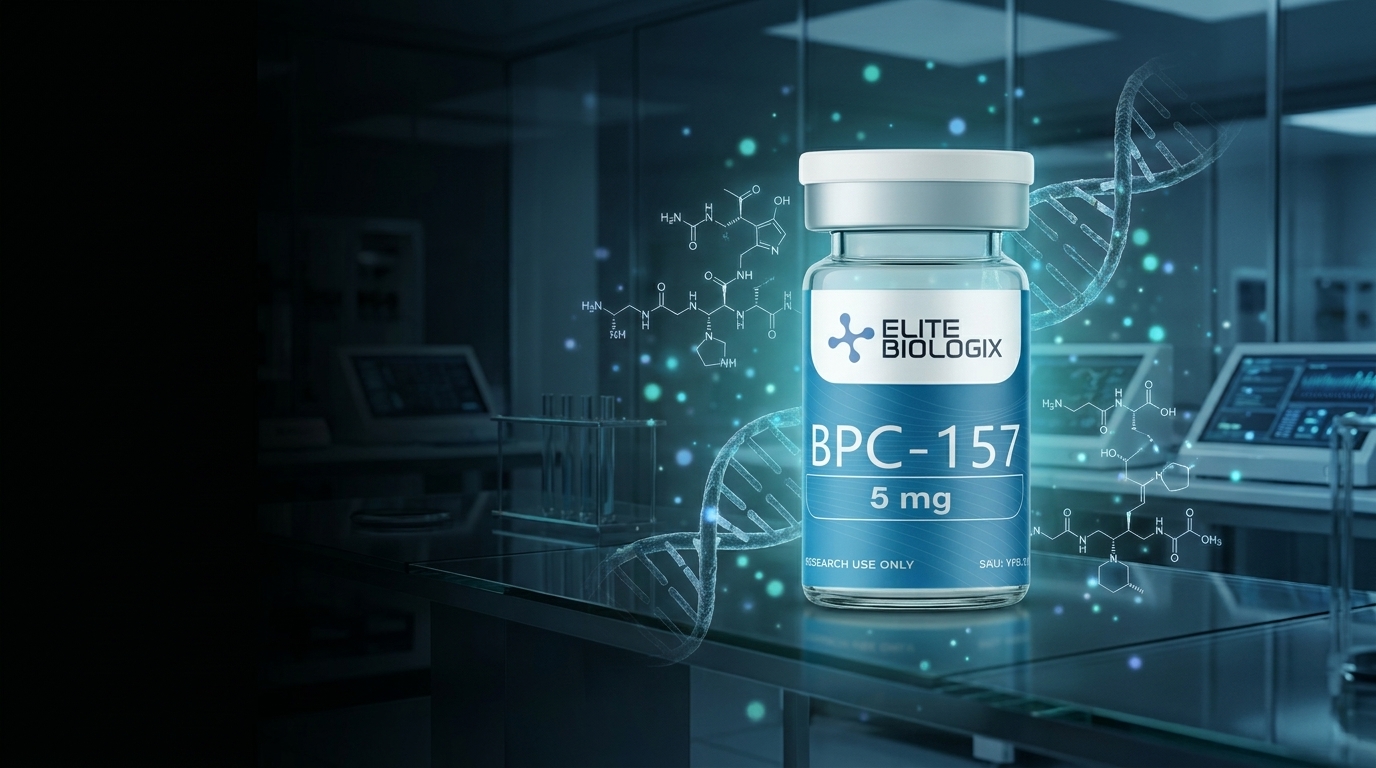
BPC-157 Research Peptide: What Preclinical Studies Reveal About This Gastric Pentadecapeptide
Published by the Elite Biologix Research Team — Compiled by clinical pharmacists with 27+ years of sterile compounding experience. Independent research compilation for scientific and educational reference only.
Key Takeaways
- BPC-157 is a synthetic 15-amino acid peptide derived from a protein found in human gastric juice, studied extensively in preclinical models since the 1990s (Józwiak et al., Pharmaceuticals, 2025).
- Rodent model studies have investigated BPC-157's interaction with the nitric oxide system and its role in gastrointestinal mucosal integrity.
- As of 2025, BPC-157 remains a research compound with no FDA approval for human or veterinary use — all available data originates from in vitro and animal model research.
- Over 100 peer-reviewed publications indexed on PubMed document preclinical investigations into BPC-157 across gastrointestinal, musculoskeletal, and neurological research contexts.
Few peptides in modern preclinical research have generated as much scientific literature as BPC-157. First identified as a fragment of a body protection compound isolated from human gastric juice, this stable synthetic pentadecapeptide has been the subject of over a decade of rodent model and in vitro investigations. Researchers studying tissue integrity, mucosal repair mechanisms, and nitric oxide signaling pathways have repeatedly turned to BPC-157 as an experimental tool.
This article reviews the published preclinical research landscape for BPC-157, with a focus on what the data actually shows — and what remains unknown — as of 2025.
What Is BPC-157? Composition and Structural Characteristics
In 2025, a comprehensive literature and patent review published in Pharmaceuticals (Basel) described BPC-157 as "a pentadecapeptide isolated from human gastric juice," noting that its amino acid sequence (Gly-Glu-Pro-Pro-Pro-Gly-Lys-Pro-Ala-Asp-Asp-Ala-Gly-Leu-Val) gives it a high degree of stability compared to other endogenous peptides (Józwiak et al., Pharmaceuticals, 2025, PMID: 40005999). That stability — particularly its resistance to enzymatic degradation — is one reason it has become a widely used probe in laboratory settings.
BPC-157 is a fully synthetic compound. It does not occur naturally in its isolated form but is derived from a sequence within a naturally occurring gastric protein. Researchers typically use it in lyophilized powder form, reconstituted in bacteriostatic water for in vitro assays or administration in animal models.
Research note: The gastric origin of BPC-157's parent protein is significant. Research into gastrointestinal cytoprotection mechanisms — the same physiological territory where BPC-157 originates — has historically yielded compounds with broad tissue-protective properties in preclinical settings. This context helps explain why investigators have studied BPC-157 across multiple organ systems, not just the GI tract.
BPC-157 and Gastrointestinal Mucosal Research: What Rodent Models Show
The most extensively published area of BPC-157 preclinical research involves gastrointestinal mucosal integrity. A 2020 study published in Current Pharmaceutical Design investigated BPC-157's effects in NSAID-induced gastrointestinal cytotoxicity models, reporting that the peptide appeared to stabilize intestinal permeability markers and modulate cytoprotective pathways in rat models (Park JM et al., Curr Pharm Des, 2020, PMID: 32445447). The investigators noted that BPC-157 appeared to interact with nitric oxide (NO) signaling — a key regulatory system in gut mucosal defense.
Seiwerth and colleagues at the University of Zagreb have published extensively on BPC-157's role in angiogenic signaling within gastrointestinal tissue models. Their 2018 review in Current Pharmaceutical Design outlined how BPC-157 appears to influence vascular endothelial growth factor (VEGF) expression and nitric oxide synthase (NOS) activity in experimental models of gut injury (Seiwerth S et al., Curr Pharm Des, 2018, PMID: 29998800).
| Research Area | Publication Volume | Primary Focus |
|---|---|---|
| GI Mucosal Research | High (30+ studies) | Mucosal integrity, NSAID cytoprotection, NOS signaling |
| Musculoskeletal | Moderate (20+ studies) | Tendon/ligament repair, cell migration, outgrowth |
| Wound Healing / Angiogenesis | Active (15+ studies) | VEGF signaling, epithelialization, granulation tissue |
| CNS / Neurological | Growing (10+ studies) | Dopaminergic/serotonergic systems, neuroprotection |
| Source: PubMed literature review, 2024. Publication counts are approximate. | ||
What makes the gastrointestinal research particularly notable is the consistency of findings across different laboratory groups. The nitric oxide modulation hypothesis — where BPC-157 appears to selectively upregulate endothelial NOS while modulating inducible NOS — has been replicated in multiple independent rodent studies. This mechanistic consistency is one reason BPC-157 has remained a subject of ongoing scientific interest for GI researchers.
Musculoskeletal and Soft Tissue Research Models
Beyond the GI tract, a substantial body of preclinical literature has examined BPC-157 in the context of musculoskeletal and soft tissue models. A 2019 review published in Cell and Tissue Research summarized animal model studies investigating BPC-157's effects on tendon, ligament, and muscle tissue, concluding that "current research suggests that BPC 157 can accelerate the healing of musculoskeletal soft tissues" in experimental models (Gwyer D et al., Cell Tissue Res, 2019, PMID: 30915550).
A 2011 study in the Journal of Applied Physiology by Chang and colleagues provided mechanistic insight, demonstrating in tendon cell culture experiments that BPC-157 promoted tendon outgrowth, enhanced cell survival under oxidative stress, and stimulated cell migration — findings consistent with a role in tissue repair signaling (Chang CH et al., J Appl Physiol, 2011, PMID: 21030672).
Research context: In pharmaceutical compounding, understanding the mechanistic basis of peptide activity is essential for quality formulation work. What the tendon research on BPC-157 highlights is the specificity of its cellular interactions — the peptide appears to act on discrete signaling pathways rather than producing broad, non-specific effects. That specificity is what makes it a useful probe for researchers studying tissue repair mechanisms.
More recently, a 2025 systematic review in HSS Journal analyzed published orthopaedic research involving BPC-157, describing the preclinical data as "emerging" and calling for controlled human clinical trials to evaluate translation of animal model findings (Vasireddi N et al., HSS J, 2025, PMID: 40756949). The authors were careful to note that extrapolation from rodent studies to human physiology requires rigorous clinical validation — a gap that, as of 2025, remains unfilled.
Wound Healing and Angiogenesis: In Vitro and Animal Model Findings
A 2021 review published in Frontiers in Pharmacology — one of the most comprehensive analyses of BPC-157's wound healing research — synthesized data from multiple preclinical investigations into the peptide's interaction with growth factor signaling, particularly VEGF and its downstream angiogenic effects (Seiwerth S et al., Front Pharmacol, 2021, PMID: 34267654). In rodent wound models, BPC-157 administration was associated with enhanced formation of granulation tissue and accelerated epithelialization compared to controls.
The proposed mechanism centers on BPC-157's apparent ability to upregulate the VEGFR2 receptor pathway — a key regulator of new blood vessel formation. In vitro endothelial cell studies have shown that BPC-157 can stimulate tubulogenesis, the cellular process by which endothelial cells organize into tube-like capillary structures. These findings have positioned BPC-157 as a research tool for investigators studying angiogenic signaling in tissue repair contexts.
CNS Research: An Emerging Preclinical Focus
A growing body of rodent model research has begun investigating BPC-157's effects on central nervous system parameters. A 2022 review in Neural Regeneration Research summarized animal studies examining BPC-157's interactions with dopaminergic and serotonergic systems, as well as its apparent neuroprotective properties in models of brain and spinal cord injury (Vukojevic J et al., Neural Regen Res, 2022, PMID: 34380875).
The CNS research is notably earlier-stage than the gastrointestinal literature. While the GI mucosal studies have decades of replication behind them, the neurological investigations represent a newer frontier — one that has generated interest but requires considerably more data before mechanistic conclusions can be drawn.
Research observation: The breadth of BPC-157's preclinical research footprint — spanning GI, musculoskeletal, wound healing, and CNS models — is itself scientifically notable. Most peptides studied in this depth show narrow tissue specificity. BPC-157's apparent multi-system activity in preclinical models suggests a mechanism operating at a fundamental biological level, likely through NO and growth factor signaling pathways common across tissue types. This is why it continues to attract research interest across multiple scientific disciplines.
Regulatory and Research Status as of 2025
It is critical to state clearly: BPC-157 has not received regulatory approval from the FDA, EMA, or any comparable authority for therapeutic use in humans or animals. All data cited in this article originates from preclinical research — in vitro cell studies and animal models, primarily rodents. The 2025 literature review in Pharmaceuticals explicitly noted that BPC-157 "has not been approved for use in standard medicine" due to the absence of comprehensive human clinical trials (Józwiak et al., 2025).
BPC-157 is available for legitimate laboratory research purposes. Researchers working in tissue repair, gastrointestinal biology, and related fields use research-grade BPC-157 as an experimental compound in controlled in vitro and animal model settings — the same contexts documented in the peer-reviewed literature reviewed here.View our BPC-157 research compound.
Frequently Asked Questions About BPC-157 Research
What is BPC-157 and where does it come from?
BPC-157 is a synthetic 15-amino acid peptide (pentadecapeptide) derived from a sequence within a protein found in human gastric juice. It is fully synthetic and does not occur in isolation naturally. In research settings, it is typically supplied as a lyophilized powder (Józwiak et al., Pharmaceuticals, 2025).
How many studies have been published on BPC-157?
As of 2025, PubMed indexes over 100 peer-reviewed publications referencing BPC-157 or "BPC 157," spanning gastrointestinal, musculoskeletal, wound healing, and neurological research contexts. The University of Zagreb group, led by researchers including Sikiric and Seiwerth, has contributed the largest single body of published work.
What research areas have most extensively studied BPC-157?
Gastrointestinal mucosal integrity research represents the highest publication volume for BPC-157. Rodent models of NSAID-induced gut damage, colitis, and mucosal repair have been the most consistently studied contexts. Musculoskeletal soft tissue models — tendons and ligaments — represent the second largest area of investigation (Gwyer et al., Cell Tissue Res, 2019).
Is BPC-157 approved for human use?
No. As of 2025, BPC-157 has not been approved by the FDA, EMA, or any equivalent regulatory body for use in humans or animals. It is available strictly as a research compound for in vitro and animal model studies. All published clinical data is preclinical in nature.
What purity grade is required for BPC-157 in research settings?Third-party certificate of analysis documentation is standard practice in qualified research supply chains to confirm identity, purity, and composition.
Conclusion
BPC-157 occupies a unique position in peptide research: it has one of the deepest preclinical literature profiles of any synthetic peptide, spanning multiple tissue systems and biological mechanisms. The gastrointestinal mucosal research is particularly well-developed, with consistent findings across independent laboratory groups over more than two decades. Musculoskeletal and wound healing investigations have added mechanistic depth, particularly around nitric oxide and VEGF signaling pathways.
What remains clear is that BPC-157's scientific story is still being written. The transition from preclinical promise to clinical evidence requires rigorous human trial data that, as of 2025, does not yet exist. For the research community, that gap represents both a limitation and an opportunity — one that continues to make BPC-157 one of the most actively investigated synthetic peptides in the preclinical literature.
For researchers sourcing BPC-157 for laboratory use, purity verification and supply chain documentation are essential. Elite Biologix provides third-party verified BPC-157 at ≥98% purity for qualified research applications.
References
- Józwiak M, Bauer M, Kamysz W, Kleczkowska P. Multifunctionality and Possible Medical Application of the BPC 157 Peptide-Literature and Patent Review. Pharmaceuticals (Basel). 2025;18(2):226. PMID: 40005999
- Gwyer D, Wragg NM, Wilson SL. Gastric pentadecapeptide body protection compound BPC 157 and its role in accelerating musculoskeletal soft tissue healing. Cell Tissue Res. 2019;377(2):153-159. PMID: 30915550
- Vasireddi N, Hahamyan H, Salata MJ, et al. Emerging Use of BPC-157 in Orthopaedic Sports Medicine: A Systematic Review. HSS J. 2025. PMID: 40756949
- Seiwerth S, Milavic M, Vukojevic J, et al. Stable Gastric Pentadecapeptide BPC 157 and Wound Healing. Front Pharmacol. 2021;12:627533. PMID: 34267654
- Park JM, Lee HJ, Sikiric P, Hahm KB. BPC 157 Rescued NSAID-cytotoxicity Via Stabilizing Intestinal Permeability and Enhancing Cytoprotection. Curr Pharm Des. 2020;26(25):2911-2918. PMID: 32445447
- Seiwerth S, Rucman R, Turkovic B, et al. BPC 157 and Standard Angiogenic Growth Factors. Curr Pharm Des. 2018;24(18):1929-1937. PMID: 29998800
- Vukojevic J, Milavić M, Perović D, et al. Pentadecapeptide BPC 157 and the central nervous system. Neural Regen Res. 2022;17(3):482-487. PMID: 34380875
- Chang CH, Tsai WC, Lin MS, et al. The promoting effect of pentadecapeptide BPC 157 on tendon healing involves tendon outgrowth, cell survival, and cell migration. J Appl Physiol. 2011;110(3):774-780. PMID: 21030672
This article is intended for research and educational purposes only. BPC-157 is not approved by the FDA or any regulatory authority for human or veterinary use. All referenced studies are preclinical in nature (in vitro or animal models). Elite Biologix products are supplied exclusively for laboratory research use.