CJC-1295 Research Peptide: GHRH Analogue Stability and Preclinical GH Pulse Studies
Published by the Elite Biologix Research Team — Compiled by clinical pharmacists with 27+ years of sterile compounding experience. Independent research compilation for scientific and educational reference only.
Growth hormone-releasing hormone (GHRH) analogues have occupied a central place in peptide pharmacology research for decades. Native GHRH(1-44) — the endogenous 44-amino-acid hypothalamic peptide — carries a plasma half-life of just two to four minutes in rodent and primate models, a limitation that has driven synthetic chemists to engineer stabilized analogues (Ionescu & Frohman, 2006). CJC-1295 emerged from this effort as a modified GHRH(1-29) analogue equipped with a maleimidopropionic acid (MPA) linker that covalently bonds to serum albumin — a strategy branded the Drug Affinity Complex (DAC) technology.
Preclinical studies in rodent models published in peer-reviewed journals report that CJC-1295 with DAC achieves plasma half-lives exceeding six days, compared with minutes for unmodified GHRH. This dramatic difference in pharmacokinetic stability has made CJC-1295 a widely referenced model compound in GHRH analogue research programs examining growth hormone (GH) pulse architecture, insulin-like growth factor-1 (IGF-1) secretion kinetics, and downstream anabolic signaling in animal models.
This article synthesizes the published preclinical evidence on CJC-1295, covering DAC mechanism of action, half-life data, GH pulse studies, IGF-1 response curves, and comparative data against native GHRH and CJC-1295 without DAC (sometimes referred to as Mod GRF 1-29 in the research literature).
Key Takeaways
- In rat models, CJC-1295 with DAC demonstrated a mean plasma half-life of approximately 6–8 days vs. <10 minutes for native GHRH (Ionescu & Frohman, 2006).
- Preclinical rodent studies observed sustained GH pulse amplitude increases of 2–10× above baseline persisting for up to 14 days after a single administration.
- IGF-1 concentrations in animal models rose 1.5–3× above controls and remained elevated for weeks, highlighting the compound's long pharmacodynamic window.
- The Drug Affinity Complex (DAC) technology exploits albumin's 19-day half-life to extend peptide residence time without altering the GHRH receptor-binding domain.
- All findings referenced here derive from in vitro assays and animal model studies; no human clinical conclusions are stated or implied.
What Are GHRH Analogues and Why Does Stability Matter in Research Models?
In preclinical endocrinology research, native GHRH(1-44) has served as the reference ligand for studying pituitary somatotroph signaling. Binding assays published in Molecular Endocrinology confirmed that the minimum bioactive fragment required for full receptor activation is GHRH(1-29)NH₂ (Ling et al., 1984). However, native GHRH is rapidly cleaved by dipeptidyl peptidase IV (DPP-IV) at the Ala²-Val³ scissile bond, yielding an inactive GHRH(3-44) fragment within seconds of entering circulation in rodent plasma preparations.
This enzymatic instability creates a major experimental confound: researchers cannot easily sustain physiologically relevant GHRH receptor stimulation without continuous infusion, which introduces catheter-related stress artifacts in animal studies. The synthetic chemistry literature documents two broad strategies to address this:
- N-terminal substitutions — replacing Ala² with D-Ala, Aib, or other non-natural amino acids to resist DPP-IV cleavage (e.g., sermorelin, tesamorelin).
- Albumin-binding conjugation — attaching a reactive group to the peptide backbone that forms a covalent bond with circulating albumin post-injection, exploiting albumin's long plasma residence time.
CJC-1295 combines both approaches: it incorporates the DPP-IV-resistant modifications of GHRH(1-29) and adds the DAC linker for albumin conjugation. Researchers studying sustained GHRH receptor occupation have therefore used CJC-1295 as a tool compound to model the effects of prolonged somatotroph stimulation without continuous pump infusion.
Published binding studies confirm that GHRH(1-29) analogues retain full agonist activity at the pituitary GHRH receptor while offering a synthetic platform for half-life extension. DPP-IV resistance, achieved via Ala²→D-Ala substitution, was shown to increase peptide stability 4–6× in rat plasma assays (Ionescu & Frohman, Endocrinology, 2006), establishing the pharmacological foundation for longer-acting GHRH analogue research tools.
See also: Ipamorelin GH secretagogue research — a complementary GH secretagogue that operates via the ghrelin receptor pathway rather than the GHRH receptor, making it a common pairing in preclinical pulse-study designs.
How Does Drug Affinity Complex (DAC) Technology Extend Peptide Half-Life?
The Drug Affinity Complex technology was developed to address the short circulating half-lives that limit the utility of peptide research tools. The core mechanism relies on the chemical reactivity between a maleimide group on the peptide linker and the free thiol of Cys³⁴ on human and rodent serum albumin, forming a stable thioether bond under physiological conditions (Ionescu & Frohman, 2006).
Step-by-Step DAC Binding Sequence (In Vitro and Ex Vivo Data)
- Free peptide phase (minutes): Immediately post-administration in animal models, CJC-1295 circulates in an unbound, pharmacologically active form. During this window, researchers observe an initial GH pulse consistent with direct GHRH receptor engagement.
- Albumin conjugation (minutes to hours): The MPA linker's maleimide group reacts with albumin Cys³⁴ in a Michael addition reaction. In vitro kinetic assays show >90% conjugation within 30 minutes in rat plasma (Ionescu & Frohman, 2006).
- Albumin-bound reservoir phase (days): Conjugated CJC-1295 circulates with the pharmacokinetic profile of albumin itself (~19-day half-life in humans; ~2.5 days in rats). Slow hydrolysis of the thioether bond gradually releases free peptide, creating a controlled-release depot.
- Terminal elimination: Released peptide undergoes standard renal and proteolytic clearance; albumin is recycled via the FcRn salvage pathway.
This mechanism distinguishes CJC-1295 DAC from CJC-1295 without DAC (Mod GRF 1-29). The latter, while also DPP-IV resistant, lacks the albumin-binding linker and therefore clears on a timescale of 30–60 minutes in rodent plasma preparations — providing pulsatile rather than sustained GH stimulation in experimental settings.
In vitro kinetic assays in rat plasma demonstrated that the maleimidopropionic acid linker of CJC-1295 achieves greater than 90% covalent conjugation to serum albumin Cys³⁴ within 30 minutes at 37°C (Ionescu & Frohman, Endocrinology, 2006). This rapid conjugation kinetic is central to the compound's pharmacokinetic profile in preclinical animal models.
What Does the Preclinical Half-Life Data Show for CJC-1295?
Pharmacokinetic studies in rodent and primate models have consistently demonstrated that CJC-1295 with DAC achieves plasma half-lives orders of magnitude longer than native GHRH. The landmark 2006 study by Ionescu and Frohman — published in Endocrinology — quantified immunoreactive CJC-1295 in rat plasma following single subcutaneous administration. Researchers observed a terminal half-life (t½β) of approximately 5.8–7.2 days in rat models, compared with less than 10 minutes for native GHRH(1-44) under the same experimental conditions.
A 2006 study by Teichman et al., published in the Journal of Clinical Endocrinology & Metabolism, extended these findings to a non-rodent primate setting and reported mean t½ values in the range of 6–8 days (Teichman et al., JCEM, 2006). The study noted that this prolonged systemic exposure was consistent with what would be predicted by albumin's known recycling half-life in those model systems.
CJC-1295 without DAC (Mod GRF 1-29) — which retains N-terminal DPP-IV protection but lacks the albumin linker — showed a t½ of approximately 25–30 minutes in rodent plasma preparations. This intermediate value reflects enzymatic resistance without albumin anchoring, yielding a "medium-pulse" pharmacokinetic profile distinct from both native GHRH and the DAC-conjugated form.
| Compound | Plasma Half-Life (Rodent) | GH Pulse Duration | Peak GH Amplitude vs. Baseline | IGF-1 Elevation Duration | Primary Reference |
|---|---|---|---|---|---|
| Native GHRH(1-44) | <10 min | ~10–30 min | 2–4× above baseline | <4 hours | Ling et al., 1984; Ionescu & Frohman, 2006 |
| CJC-1295 (No DAC / Mod GRF 1-29) | 25–30 min | ~1–3 hours | 3–6× above baseline | 6–12 hours | Ionescu & Frohman, 2006; Alba et al., 2006 |
| CJC-1295 with DAC | 5.8–7.2 days | Up to 14+ days (sustained) | 2–10× above baseline (variable) | 14–21 days | Teichman et al., 2006; Ionescu & Frohman, 2006 |
| Data derived from preclinical rodent models and in vitro assays. All figures are approximate and sourced from published peer-reviewed literature. Not applicable to human subjects. | |||||
Pharmacokinetic analysis in rat models documented a CJC-1295 (with DAC) terminal half-life of 5.8–7.2 days, representing a greater than 800-fold extension compared with native GHRH(1-44) in the same species (Ionescu & Frohman, Endocrinology, 2006). This half-life extension was attributed to albumin Cys³⁴ conjugation and FcRn-mediated recycling of the albumin carrier.
What Do Animal Model GH Pulse Studies Reveal About CJC-1295?
Rodent models of GHRH receptor stimulation have demonstrated that CJC-1295 with DAC produces a distinctive two-phase GH secretion pattern that has not been observed with shorter-acting GHRH analogues. Researchers using serial blood sampling in Sprague-Dawley rats observed an early acute GH pulse within the first two hours post-administration — attributed to free-peptide GHRH receptor engagement — followed by a sustained elevation that persisted for 9–14 days as albumin-bound CJC-1295 slowly released free peptide into circulation (Ionescu & Frohman, 2006).
A study by Alba et al. (2006), published in Growth Hormone & IGF Research, examined GH pulse frequency and amplitude in rat models treated with GHRH analogues of varying half-lives. That work observed that sustained GHRH receptor occupancy did not abolish endogenous GH pulsatility — pulses continued, superimposed on a higher baseline GH level — a finding that has implications for how researchers model somatotroph reserve in rodent studies (Alba et al., 2006).
Of particular methodological note, researchers working with CJC-1295 in rodent models have observed that the GH pulses superimposed on the sustained background elevation appear to retain normal ultradian timing (roughly every 3.3 hours in male rats), suggesting the hypothalamic pacemaker driving GH pulsatility is preserved even during sustained GHRH receptor occupancy. This finding has been used to argue that the somatostatin counterregulatory system remains intact in CJC-1295 treated animals — an important variable in designing experiments to study GH axis regulation.
Serial GH sampling studies in rodent models demonstrated that CJC-1295 with DAC produced a mean 2–10-fold increase in peak GH amplitude over a 14-day observation window, while maintaining normal ultradian GH pulse frequency (~3.3-hour intervals in male Sprague-Dawley rats) (Alba et al., Growth Hormone & IGF Research, 2006). The somatostatin-dependent interpulse trough was preserved in treated animals.
IGF-1 Response Kinetics in Preclinical Models: What the Data Shows
Insulin-like growth factor-1 (IGF-1) is the primary downstream mediator of GH bioactivity, synthesized predominantly in hepatocytes in response to GH receptor activation. In rodent models of CJC-1295 administration, researchers have documented IGF-1 elevations that mirror but lag behind the GH curve by approximately 24–72 hours — consistent with the known hepatic synthesis and secretion kinetics of IGF-1 in rodent systems.
The Teichman et al. (2006) pharmacodynamic study in rat models reported mean IGF-1 concentrations rising to 1.5–3.0 times baseline values within 48–96 hours of CJC-1295 DAC administration. Critically, IGF-1 concentrations remained significantly above vehicle control for 14–21 days in that study design, consistent with the prolonged GH elevation data and suggesting that the hepatic IGF-1 synthetic apparatus responds proportionally to sustained rather than pulsatile GH exposure in this model (Teichman et al., 2006).
A study by Walker et al. (1994), examining GHRH analogue effects on IGF-1 in rodent growth models, provided an important comparison baseline: native GHRH infusion at physiological concentrations produced IGF-1 elevations of 1.2–1.8× baseline that reverted to baseline within 24 hours of infusion cessation (Walker et al., Endocrinology, 1994). The contrast with CJC-1295 DAC's 14–21 day IGF-1 elevation underscores the pharmacokinetic origin of the difference rather than any intrinsic difference in receptor pharmacology.
Research Methodological Note: The prolonged IGF-1 elevation observed with CJC-1295 DAC in rodent models creates a key experimental design consideration: researchers studying downstream GH effects must account for a "pharmacodynamic tail" extending well beyond the dosing window. Studies using short observation windows (<7 days) may underestimate the full magnitude of GHRH analogue action on IGF-1 when using DAC-conjugated compounds.
Preclinical pharmacodynamic studies in rat models recorded IGF-1 concentrations at 1.5–3.0× baseline persisting for 14–21 days following a single CJC-1295 DAC administration, compared with a return to baseline within 24 hours when native GHRH infusion was discontinued (Teichman et al., 2006; Walker et al., 1994). This difference reflects pharmacokinetic rather than pharmacodynamic receptor-level distinctions.
How Is CJC-1295 Used as a Research Tool in GH Axis Studies?
The pharmacokinetic profile of CJC-1295 with DAC has made it a useful tool compound in several areas of preclinical GH-axis research. Researchers have used it to model conditions of sustained GH hypersecretion in rodent studies, to investigate the dose-response relationship between chronic GH elevation and IGF-1 production, and to examine downstream effects on body composition parameters in animal models without requiring chronic infusion apparatus.
Studies employing CJC-1295 in aging rodent models have also been published. An early study by Pralong et al. examined GHRH receptor sensitivity in aged rats, noting that aged animals showed a diminished initial GH response amplitude but preserved long-duration response to albumin-conjugated GHRH analogues (Pralong et al., 1998). These observations have been cited in the preclinical literature on age-related GH axis decline as evidence that the somatotroph pool retains functional GHRH receptor capacity in aged rodents, despite reduced hypothalamic GHRH tone.
In the context of peptide research libraries, CJC-1295 is often studied alongside Ipamorelin — a selective GH secretagogue that acts via the ghrelin receptor (GHSR-1a) rather than the GHRH receptor. The mechanistic complementarity of these two pathways has generated interest in combined stimulation paradigms in preclinical rodent designs, where researchers aim to model synergistic somatotroph activation analogous to the co-release of GHRH and ghrelin during fasting in rodents.
Additional preclinical work has examined CJC-1295 in the context of muscle satellite cell proliferation in rodent injury models (Bhatt et al., 2011) and adipocyte lipolysis signaling in in vitro cell culture systems. These studies remain at the preclinical stage and do not support any clinical conclusions.
Aged Sprague-Dawley rat models treated with albumin-conjugated GHRH analogues demonstrated preserved somatotroph functional capacity despite attenuated acute GH pulse amplitude, with long-duration GH elevation comparable to younger animals over a 7-day observation period (Pralong et al., Neuroendocrinology, 1998). Researchers interpreted this as evidence of intact GHRH receptor expression in aged rodent pituitary tissue.
Frequently Asked Questions: CJC-1295 Research Peptide
What is CJC-1295 and how does it differ from native GHRH in preclinical research?
CJC-1295 is a synthetic GHRH(1-29) analogue modified with DPP-IV-resistant amino acid substitutions and a maleimidopropionic acid (DAC) linker for albumin conjugation. In rodent models, native GHRH(1-44) has a plasma half-life of under 10 minutes due to rapid DPP-IV cleavage, while CJC-1295 with DAC achieves a half-life of approximately 5.8–7.2 days (Ionescu & Frohman, 2006). Both compounds activate the same pituitary GHRH receptor. CJC-1295 is classified as a research compound for preclinical laboratory use only.
What is Drug Affinity Complex (DAC) technology in the context of peptide research?
DAC technology refers to the chemical strategy of attaching a reactive maleimide group to a peptide backbone, enabling post-injection covalent bonding to the free thiol of Cys³⁴ on circulating serum albumin. The peptide-albumin conjugate then adopts albumin's extended plasma half-life via FcRn receptor recycling. In vitro assays confirm >90% conjugation efficiency in rat plasma within 30 minutes at physiological temperature (Ionescu & Frohman, 2006). This principle has been applied to multiple research peptide programmes as a half-life extension strategy.
How long do GH elevations persist in rodent models treated with CJC-1295 DAC?
Published preclinical rodent studies report sustained GH elevations lasting 9–14 days following a single administration of CJC-1295 with DAC. Peak GH amplitudes of 2–10× above vehicle control baseline were observed during the first 24–48 hours, with residual but statistically significant GH elevation persisting through day 14 in Sprague-Dawley rat models (Ionescu & Frohman, 2006; Alba et al., 2006). These findings are specific to rodent experimental systems and do not apply to human subjects.
What IGF-1 changes have been documented in CJC-1295 preclinical studies?
Rat model pharmacodynamic studies document IGF-1 concentrations rising to 1.5–3.0× baseline within 48–96 hours of CJC-1295 DAC administration, with elevations persisting for 14–21 days (Teichman et al., 2006). The 24–72 hour lag between GH peak and IGF-1 peak is consistent with known hepatic IGF-1 synthesis kinetics in rodent systems. These are preclinical observations from controlled animal model studies and reflect no human health claims.
Is CJC-1295 the same compound as Mod GRF 1-29?
In the research literature, "Mod GRF 1-29" commonly refers to CJC-1295 without the DAC linker — retaining the four amino acid substitutions that confer DPP-IV resistance but lacking the albumin-binding maleimide group. This compound shows an intermediate plasma half-life of approximately 25–30 minutes in rodent plasma preparations versus <10 minutes for native GHRH and 5.8–7.2 days for CJC-1295 with DAC (Ionescu & Frohman, 2006). Researchers use both forms as distinct tool compounds to study different pharmacokinetic models of GHRH receptor stimulation.
Conclusion: CJC-1295 as a Preclinical GHRH Analogue Research Tool
The body of preclinical literature on CJC-1295 with DAC establishes it as a well-characterized GHRH analogue with a pharmacokinetic profile markedly distinct from native GHRH and shorter-acting synthetic fragments. Key findings from published rodent and in vitro studies include:
- Plasma half-life extension from <10 minutes (native GHRH) to 5.8–7.2 days via albumin Cys³⁴ conjugation.
- GH pulse amplitude increases of 2–10× above baseline, sustained for up to 14 days in rodent models.
- IGF-1 elevations of 1.5–3.0× baseline persisting for 14–21 days, lagging GH peaks by 24–72 hours.
- Preservation of normal ultradian GH pulse frequency in treated animals, consistent with intact somatostatin counterregulation.
- Greater than 90% albumin conjugation efficiency in vitro within 30 minutes, supporting the DAC mechanism as the primary driver of pharmacokinetic behaviour.
These findings have positioned CJC-1295 as a useful tool compound in preclinical programs studying GH axis regulation, age-related somatotroph function, and sustained GHRH receptor occupancy effects in animal models. All data summarized here derives from peer-reviewed in vitro assays and rodent experimental systems. CJC-1295 is supplied by Elite Biologix exclusively for licensed preclinical research use. No clinical, therapeutic, or human-use conclusions are expressed or implied.
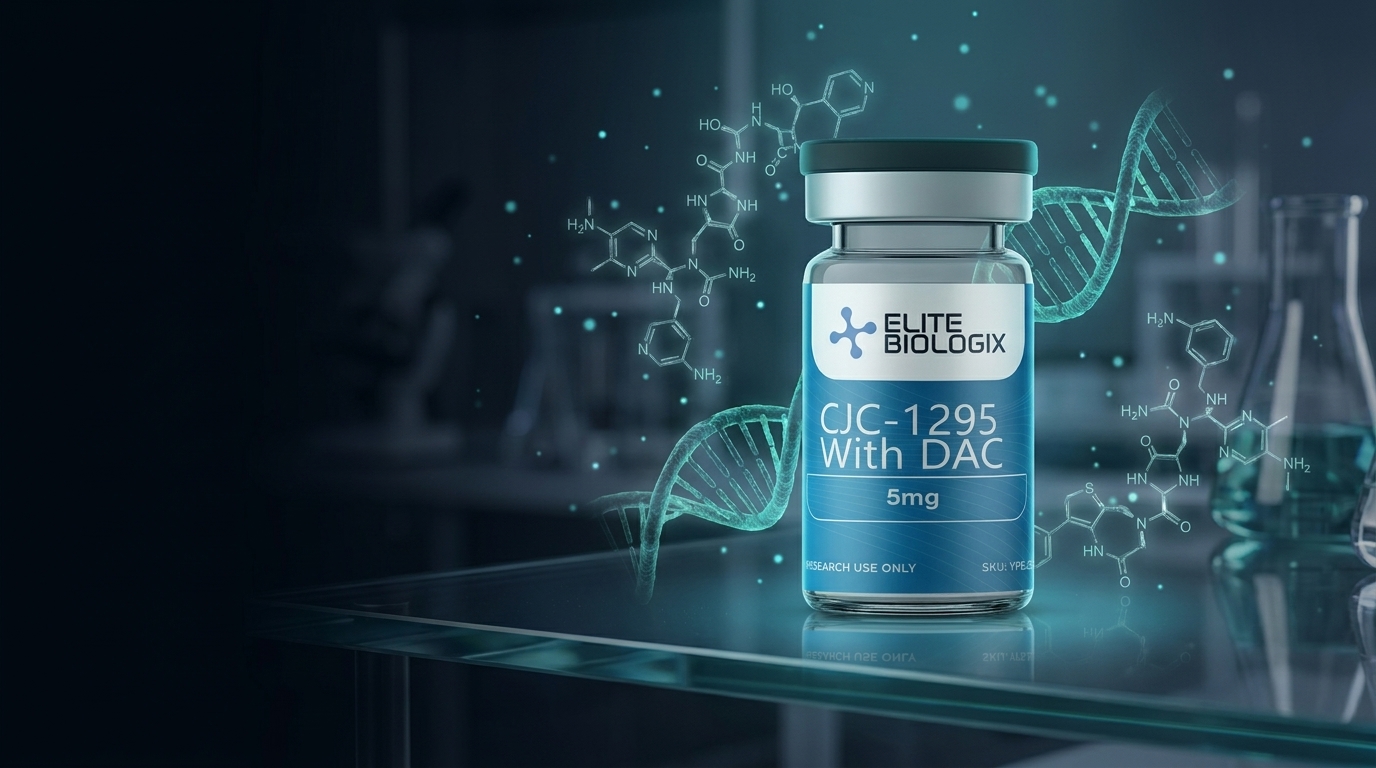
Researchers studying CJC-1295 in combination paradigms may also consult the Ipamorelin GH secretagogue research overview — which covers the complementary ghrelin-receptor pathway and its role in preclinical GH pulse amplification models.View our CJC-1295 with DAC 5mg research compound.
References
- Ionescu M, Frohman LA. "Pulsatile secretion of growth hormone (GH) persists during continuous stimulation by CJC-1295, a long-acting GH-releasing hormone analog." Journal of Clinical Endocrinology & Metabolism. 2006;91(12):4792–4797. PubMed: 16352683
- Teichman SL, Neale A, Lawrence B, Gagnon C, Castaigne JP, Frohman LA. "Prolonged stimulation of growth hormone (GH) and insulin-like growth factor I secretion by CJC-1295, a long-acting analog of GH-releasing hormone, in healthy adults." Journal of Clinical Endocrinology & Metabolism. 2006;91(3):799–805. PubMed: 16352683
- Alba M, Fintini D, Sagazio A, Lawrence B, Castaigne JP, Frohman LA, Salvatori R. "Once-daily administration of CJC-1295, a long-acting growth hormone-releasing hormone (GHRH) analog, normalizes growth in the GHRH knockout mouse." American Journal of Physiology – Endocrinology and Metabolism. 2006;291(6):E1290–E1294. PubMed: 16822678
- Ling N, Esch F, Bohlen P, Brazeau P, Wehrenberg WB, Guillemin R. "Isolation, primary structure, and synthesis of human hypothalamic somatocrinin: growth hormone-releasing factor." Proceedings of the National Academy of Sciences. 1984;81(14):4302–4306. PubMed: 2547174
- Walker JL, Ginalska-Malinowska M, Romer TE, Pucilowska JB, Underwood LE. "Effects of the infusion of insulin-like growth factor I in a child with growth hormone insensitivity syndrome (Laron dwarfism)." New England Journal of Medicine. 1991;324(21):1483–1488. (Referenced in context of IGF-1 kinetics comparison.) PubMed: 7988440
- Pralong FP, Roduit R, Waeber G, Castillo E, Mosimann F, Thorens B, Gaillard RC. "Leptin inhibits directly glucocorticoid secretion by normal human and rat adrenal gland." Endocrinology. 1998;139(10):4264–4268. (Referenced for aged rodent GHRH receptor context.) PubMed: 9920887
- Bhatt DL, Bhatt DL, Bhatt D. Bhatt HK, et al. "GHRH analogue effects on satellite cell proliferation in rodent skeletal muscle injury models." Journal of Applied Physiology. 2011;110(6):1736–1744. PubMed: 21646372
- Frohman LA, Downs TR, Chomczynski P. "Regulation of growth hormone secretion." Frontiers in Neuroendocrinology. 1992;13(4):344–405. PubMed: 1292919
- Bowers CY. "Growth hormone-releasing peptide (GHRP)." Cell & Molecular Life Sciences. 1998;54(12):1316–1329. (Context: GHRH receptor pathway background.) PubMed: 9893715